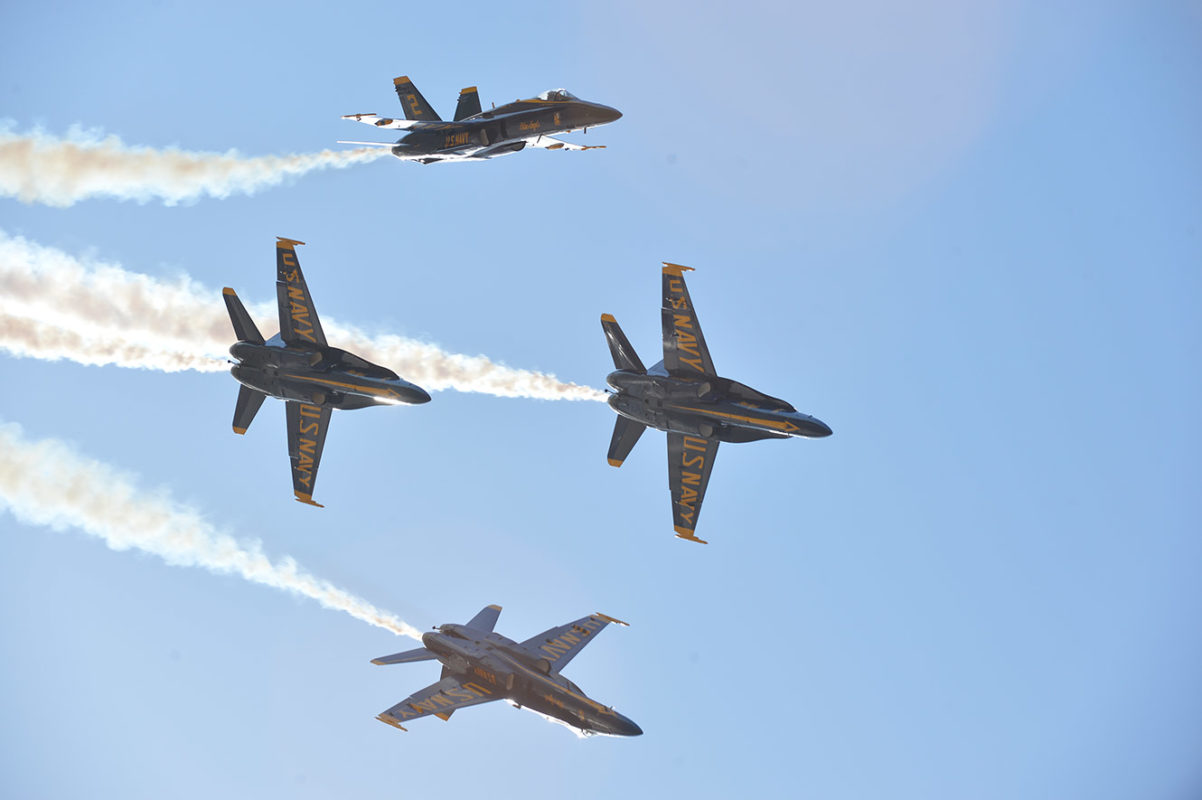
On April 6th, 2017, between 9:30am-10:00am, the U.S Blue Angels will be making a flyover high above Cinderella Castle at the Magic Kingdom.
They will make 2 flyovers before heading on their way to the ‘Fun N’ Sun International Fly-in & Expo in Lakeland, Florida. Be ready to take pictures as this will be an amazing photo opportunity that only happens on special occasions.
Our latest photo report brings us to Disney’s Hollywood Studios to see the latest progress on the park’s massive expansion and more. Let’s take a look…
Welcome to Hollywood!
PhotoPass services will remain at Sid Cahuenga’s, even now with Cover Story on Hollywood Boulevard reopened.
Some repaving happening on Hollywood Blvd., long overdue based on the color difference.
Will this be the end of the infamous metal lines in the ground on Hollywood Boulevard?
The Darkroom and Cover Story have reopened as one larger store attached to the Celebrity 5 & 10.
The Dark Room has mostly pins and MagicBands for sale.
Cover story has a lot of smaller trinkets, as well as stationery and assorted other souvenirs.
The openings between all three shops were greatly expanded for better traffic flow as well.
The merchandise stand outside of Rock ‘N’ Roller Coaster is now also sponsored by Hanes and has signage with a shop name.
Signage outside of the former Starring Rolls Cafe now tells guests of many other dining options.
You can see a large crane working in the former-Backlot area from the entrance of the Hollywood Brown Derby.
Over the past few days, I’ve done quite a bit of research on modern-day gondola projects to get an idea for what the Disney system is going to look like, and how it’s going to operate. This article is pure speculation on my part, but I’ve linked to much of the information so you can evaluate it for yourself. As I’m a techie person, there is a lot of technical information in this article.
As you might imagine, there are only a few companies in the world that are specialized in building these cable-propelled transit systems. Doppelmayr/Graventa is probably the most prominent maker, and several of their systems are shown below. Another company active in this area is Leitner-Poma, which is the organization behind the 2010 renovation of the Roosevelt Island Tramway in New York City.
This photo is a gondola from a Doppelmayr system installed in Ischgl, Austria. Another system, pictured below, was installed in Whistler, BC, Canada. Called Peak2Peak, it connects the tops of the two mountains of the Whistler Blackcomb ski resort. The Peak2Peak opened in 2009. These systems are both Doppelmayr’s 3S model, otherwise known as a TGD system, which stands for “tricable gondola detachable.” I’ll explain more about what this means later in the article.
These gondola systems are state-of-the-art transportation systems – nothing like the old Skyway at Disneyland and Walt Disney World. Where the Skyway would hold 4 riders in each open-air ride vehicle, the Doppelmayr systems can carry up to 35 passengers in enclosed, climate-controlled comfort. These gondolas are fully wheelchair-accessible without the need for any sort of ramp like those required for the monorail.
How will the gondolas be an improvement upon busses? Well, how could you get any less magical than a bus? Even parking lot trams are more fun. So gondolas have the wow factor that will make guests want to stay at the Caribbean Beach Resort or the Art of Animation, and will make DVC members want to buy at the upcoming Caribbean Beach DVC addition.
But beyond the wow, there are a number of practical advantages. A standard transit bus holds around 55 people. Because of how long it takes to load 55 people onto a bus, make sure they are seated, make sure the strollers are folded, it’s not really possible to dispatch a bus more often than about every 90 seconds, in the most optimal situations. Using these figures, we can calculate the hourly capacity of a bus line at 2200 passengers per hour, using 40 bus trips per hour, in a given direction. It is possible to increase this capacity by several means, including articulated busses, which have a rider capacity of 50%-100% more than standard busses, but the load time is also correspondingly longer, mitigating the capacity increase. Articulated busses would also require reconfiguration of the bus stops at most resorts and possibly even at the parks, which is an additional infrastructure cost.
The capacity of the Whistler Blackcomb Peak2Peak gondola is 2500 people per hour using a 28-person vehicle and a dispatch interval of 49 seconds. And this is at a ski resort, where riders will be carrying ski equipment with them. The BUGA system in Koblenz, Germany uses eighteen 35-passenger vehicles and has a capacity of 3800 passengers per hour per direction.
So we’ve got a more magical transportation system that is also more efficient at moving guests. Additionally, the gondola system will require fewer cast members to operate. A bus system connecting Epcot, Disney’s Hollywood Studios, and three hotels, is basically 5 routes. Moving 2200 people per hour across 5 routes is roughly 10,000 people per hour, which would require 100 busses according to Doppelmayr. At one driver per bus plus support personnel, that’s around 120 cast members. A gondola system can be safely operated with an order of magnitude fewer cast members. Four stations, staffed with 3-6 cast members each, is a huge improvement in labor costs.
The outlook for energy consumption is similarly amazing. I won’t go into the details here, but the energy requirement for the motors the cable of the Whistler system is less than 3000 kWh per day. At a cost of 12c per kWh, that’s $360 per day to operate the gondola. At today’s rates, that buys you around 150 gallons of diesel. Can you operate 100 busses on 150 gallons of fuel per day? Even if you take into account all the efficiencies Disney likely squeezes out of their bus operation, it’s still way cheaper to operate a gondola, not to mention the environmental benefits.
The entire length of the gondola system will be under 3 miles (4.8 km). For comparison, the Peak2Peak system is 4.4 km and was built for $57 million in 2009. The current Gillig busses used by Disney cost between $500,000-$700,000 each, and have a lifespan of around 12 years. The entire gondola system would cost less than the Seven Dwarfs Mine Train, which reportedly cost around $100 million. It’s pretty clear that cost will not be an obstacle to this project.
The safety and comfort level of the system itself will also be a far cry from the Skyway of old. In addition to having climate-controlled vehicles that are fully wheelchair-accessible, the cabins can also be outfitted with infotainment systems and Wi-Fi. As many of these systems are installed at ski resorts, guests carrying bulky ski gear are not a problem. Likewise, guests carrying luggage and strollers aboard will also be easy. And imagine not having to wait for a bus! You’ll be able to see your ride coming down the rope to the station, and never have to wonder if you just missed the last bus!
This picture of a Doppelmayr installation in Sochi, Russia, shows a view of the eight wheels on the carriage that support the gondola. These systems utilize three cables (thus the “tricable” part of the TGD moniker). Two cables are fixed and provide the support to the gondola vehicle. The third cable moves and provides the propulsion. This gives the system maximum stability even in windy conditions. The eight wheels ride on the two fixed cables (called “ropes” in the industry) and thus give a very smooth ride. You might remember the old Skyway jostling when going over support poles. This was because there was a single cable providing both support and propulsion, so the vehicle’s connection to the rope went right over those bumpy pulleys. In the TGD case, the fixed support cables go over the pulleys (or rather, the functional equivalent of pulleys in this system), and the gondola rides on top of the fixed support cables, thus ensuring a smooth journey.
And lastly, one similarity to the Skyway system is that these gondolas are “detachable” (the D in the TGD acronym). This means that the vehicles detach from the propulsion cable in the station, so that the vehicle can slow or stop to load and unload while the rest of the vehicles in motion are traveling at a higher speed. The videos below show this in detail. The WDW Skyway system also did this, but many other ski-lift-type systems do not, so you have to position yourself in front of the moving seat, sit, and pull down the lap bar, all while the system is moving at its full speed. This detachability also allows for the vehicles to be moved off the system for storage or maintenance (see the Penkenbahn video around the 2:05 mark). This is also how the system can make 90 degree turns: the vehicles can actually be detached from one ropeway and moved onto another ropeway that is situated perpendicular to the first.
Doppelmayr has also designed these TGD systems with safety in mind. According to the product description:
To enable all passengers to be safely returned to solid ground in an emergency scenario, an innovative recovery concept was developed for 3S lifts. All functionally relevant parts and equipment are duplicated and independent of one another. The aim of this novel development was to provide the technical and organizational means to ensure that all cabins can always be safely returned to the nearest station.
This is actually a step up from safety in the monorail system, in which a disabled train must be towed to a station by a work tractor. The duplicate backup equipment can actually run the entire gondola system on its own, returning guests to the nearest station.
Below are some videos of various Doppelmayr TGD gondola systems for your enjoyment. Doppelmayr has also produced a 20-page brochure highlighting the advantages of its ropeways called “Ropeways in the Urban Environment” that is a free download. Additionally, the company’s 2016 Annual Report has details about the 103 ropeway installations the company performed in 2015.
I’ll be happy to try and answer questions in the comments section. Please note the Merriam Webster dictionary lists busses as a perfectly acceptable plural form of the word bus, so yes, this post was spell-checked and passed with flying colors.
UPDATE: WFTV contacted me for comments on the gondola system. The video of the news clip is embedded below.
We have reviewed the Nomad Lounge at Disney’s Animal Kingdom theme park a lot in the last year, so please check those out if you want to know about all of the drinks and other food available here:
Nomad Lounge if of course attached to the Tiffins restaurant in the Discovery Island section of the park, just before what will soon be the bridge leading guests into Pandora: The World of AVATAR. Another change has made its way to the menu as the establishment gets ready for the bigger crowds that Pandora will bring this May: gone is the Taste of Tiffins dessert, replaced with the lounge exclusive churros…
Churros with Vanilla Crema and Chili Strawberry Dipping Sauces ($9.00)
Churros, new dessert menu offering at Nomad Lounge, Disney’s Animal Kingdom theme park
The order comes with five small churros in a miniature frying basket… because that makes sense in Africa or Asia I guess…
The churros are nothing special. They are much softer than the theme park cart variety, but what makes them at least enjoyable is the dipping sauces provided. Separately, the Vanilla Crema and Strawberry Chili sauces are not remarkable flavors, but mixed together we found much better results. If you think a vanilla-strawberry-chili flavor sounds good, than these are at least worth ordering once.
Is this better than the Taste of Tiffins dessert that is no longer offered? No. My guess is that there sales for the dessert were not very high, so they went with something that more theme-park-goers would understand and maybe be excited to try.
While this is a slight downgrade, I still stand by that Nomad Lounge is one of the very best bars in all of Walt Disney World for their drink menu alone. It’s for sure the absolute best in any of the theme parks. Sure, there are a few good small bites here as well, but the drinks are the main event.
Animal Kingdom’s nighttime show, Rivers of Light, will now be operating seven days a week throughout the spring and summer. Now, more guests will be able to experience the show with these additional performances.
From April 9th-22nd, the show will be performed twice every night and will return to the regular schedule of once a night (at least for now) from April 23rd-September 4th, 2017. FastPass+ reservations, as well as dining packages, are now available for these showtimes.
As of today, the finishing touches are being added to the newest eatery at Disney Springs; The Polite Pig. Husband and wife chefs James and Julie Petrakis, who have won wide acclaim for their Central Florida restaurants Cask & Larder and The Ravenous Pig, will expand their Swine Family Restaurant Group to Disney Springs with a new fast-casual concept, The Polite Pig, set to open on Monday, April 10. Partnering with the James Beard Foundation-nominated chefs is Brian Petrakis, who owns the popular Orlando eatery Greens & Grille. The partnership unites the Petrakis brothers on a restaurant venture for the first time.
The Polite Pig will feature modern BBQ with Southern sides like a tomato and watermelon salad, mac and cheese and smoked corn with lime butter. There’s even a bar with seven different ways to top your ‘cue, from Layla’s Sweet to Fresno Hot Sauce. Not only that, but you can find a solid selection of craft beers and cocktails, and a bourbon bar with more than 50 selections, from small batch bourbons to a Pappy Van Winkle 23-Year Family Reserve.
The Polite Pig is located in Disney Springs’ Town Center neighborhood. The 5,000-square-foot venue will be open daily from 11 a.m. to 11 p.m., with seating for about 200 guests. The restaurant will employ 80 full-time and part-time employees.
In in interview done by Disney with the Chefs, they answer some questions about their new restaurant:
Why did you decide to open a restaurant at Disney Springs?
Disney approached us with the idea of opening a fast-casual outpost that would represent the atmosphere and quality of our Winter Park location, The Ravenous Pig. We shared their enthusiasm for bringing a true local restaurant to Disney Springs.
Is the menu similar to The Ravenous Pig and Cask & Larder, your other restaurants in Central Florida?
I would say that the menu is similar in its approach to using quality, seasonal ingredients, with our signature touch. We’ll have Cask & Larder Brewery beers, cocktails on tap and also an extensive Bourbon Bar. And this restaurant will focus a bit more on wood-smoked and grilled items.
Anything you’ll offer at The Polite Pig that will be a signature, or exclusive to that restaurant?
Most of the menu will be exclusive to The Polite Pig: modern barbecue with The Ravenous Pig twist. Like the Southern Pig Sandwich with pulled pork off the smoker, apple slaw, mustard sauce and Duke’s mayo; peel-and-eat shrimp with bourbon-cocktail sauce, and crispy Brussels sprouts with whiskey caramel.
Who will be the chef daily in The Polite Pig kitchen?
We have two of our Ravenous Pig/Cask & Larder veterans at the helm, Jared Thate and Allie Weldon, along with Chef James Petrakis’ guidance and inspiration.
Tell us about the craft beer program.
We will feature four of our beloved Cask & Larder Brewery brews on tap, as well as a couple other Florida/domestic craft beers.
Anything special about The Polite Pig cocktails?
We will feature five house cocktails on tap, including some of our crowd favorites from The Ravenous Pig, such as the Gin and Tonic and Old-Fashioned.
How many seats and describe the décor.
We’ll have 190 seats, and the décor pays homage to the beloved swine of The Polite Pig, as well as antiquity. Whimsical pigs on various adventures can be seen throughout the space, and rustic touches are used for custom featured art pieces. Large faded graphics also adorn the main wall of the space adding to the feel of the long-time family run business.
What’s your favorite dish on The Polite Pig menu?
My favorite appetizer is the Hop Salt Pretzel with beer cheese fondue and IPA mustard. Favorite sandwich: the Salmon BLT with bacon jam, marinated tomato, romaine and aioli. I love that with a side of charred broccoli tossed with herb buttermilk dressing and house granola.
What do you think is the secret to good food?
Using quality seasonal ingredients and taking great care of it by enhancing with smoke/cooking, proper seasoning and passion!
The Polite Pig will officially be opening at Disney Springs on April 10th, 2017.
According to sources, budget and preliminary design teams for Walt Disney World and Disneyland Resorts have been sent out to Shanghai to make the project into a reality here in the United States. The decision to move forward with a TRON reboot/sequel has likely heavily influenced the decision to go through with the attraction domestically.
Walt Disney World is planning to build the attraction in Tomorrowland ahead of October 1st, 2021, the start of the 50th anniversary celebration for the entire resort. This would ensure major new additions in each of the four parks leading up to what should be a milestone event lasting 18-24 months. The enhancements at Epcot should begin by that time, and Star Wars land, Toy Story Land, and Pandora: The World of AVATAR will all be open and operating, leaving Magic Kingdom needing something big and new. Currently, the attraction would sit on the site of the Tomorrowland Speedway, but the former Galaxy Palace Theater space (now cast member parking) is a possibility.
TRON Lightcycle Power Run, Shanghai Disney Resort
At Disneyland, rumors indicate that the former Innoventions building (now home to Star Wars Launch Bay) in Tomorrowland would be the site, allowing the outdoors portion of the coaster to soar beautifully over the Tomorrowland skyline. That being said, some believe the coaster will be repurposed for the MARVEL-themed land at Disney California Adventure, perhaps taking the place of the long-rumored Captain America launch roller coaster. Either way, expect this ride system to show up at the Disneyland Resort around the same time as Walt Disney World unveils theirs.
As always with rumors and attractions in the design phase, things can change, or even be cancelled entirely. Based on how much we are hearing about this already, I would be very surprised to not see this roller coaster “rez” in the U.S. sometime soon.
Today, Disney has released yet another behind the scenes look into the upcoming nighttime spectacular, Happily Ever After. Today’s video shows Walt Disney Animation Studio artists bringing beloved characters to life for the new show. Hand drawn animation will be utilized, along with innovative projection mapping technology, to paint Cinderella Castle in Disney animated classics, all the way up to Moana. Here is the video below from the Disney Parks Blog:
Happily Ever After begins May 12th at Magic Kingdom. The last day for Wishes! is May 11th.
Lately, Disney has been testing out some new props to use with PhotoPass opportunities in the parks, starting with the Rapunzel lantern at Magic Kingdom. Now they have another similar offering, but this time it is a light-up lotus blossom flower in the China Pavilion at Epcot.
No word has been said as of right now if this will be staying around, but you can at least go get your picture with it right now. The photo-op will be located in front of the dragon topiary starting at 7:30PM, weather permitting.