Ford’s Magic Skyway: The Origin of the PeopleMover

Screen Shot 2014-06-16 at 3.28.16 PM

Of all the extinct Disney attractions, nothing truly compares to Ford’s Magic Skyway. On paper, the attraction closed with the World’s Fair in 1965; however, it has a legacy that extends well beyond Flushing Meadows.

The Skyway was the first attraction that WED Enterprises (WED) developed for the 1964 World’s Fair. After approaching several other corporations about developing pavilions, WED was hired by the Ford Motor Company to develop an attraction. The result of this collaboration would not only be a wonder unto itself, but would serve as a springboard for future projects.

The Ford Pavilion was located in the transportation area of the fair, across the bridge from the United States and other country pavilions. Guests entered the pavilion via the Ford Rotunda. The rotunda was a two-story structure that served as the facade for the pavilion. The first floor served as a queue for the pavilion and displayed a variety of historic Ford Motor Company vehicles. Of more interest to Disney fans was the series of miniature displays known as the International Gardens. WED created eleven miniature scenes, including colonial America, Aztec Mexico, and Medieval Europe. The models were elaborately detailed and included water features, moving parts, and sound effects. Guests wound around these exhibits before boarding a motorized ramp that took them to the second floor. The second floor contained the loading area where guests boarded their ride vehicle: a late model Ford convertible.

The ride began by making a loop around the outside of the rotunda through a clear plastic tube that gave guests a birds-eye view of the fairgrounds. Guests were welcomed to the pavilion by Henry Ford II. As the vehicle finished the loop and entered the show building, the familiar voice of Uncle Walt took over and narrated the journey. The narration captured the epic tone of this trip through time and space while sprinkling in humor and factoids along the way.

The ride began with an elaborate display of dinosaurs. These were massive audio-animatronic figures, which had required WED to construct a temporary building for their fabrication. Next, the dawn of mankind was shown, detailing the trials and tribulations of the cave men culminating with the invention of the wheel. From here, riders jumped thousands of years into the future where the sum of mankind’s achievements could be seen in a city of the future. The post-show area was called “Fields of Science” where guests viewed prototype cars and were shown the many advancements being made by Ford scientists and engineers.

Legacy

Unlike the other Disney-built exhibits, the Skyway was not transferred in its totality to Disneyland. Instead, much of the ride was torn down. However, two features from the ride survived. The dinosaurs were saved and eventually made their way to Disneyland where they found permanent residence in the Primeval World diorama on the Disneyland Railroad.  The Ford Motor Company salvaged the stripped-down convertibles, re-engineered them and sold them to the public.

The concepts seen in the Skyway also had a long shelf life, and were the inspiration for many of EPCOT’s pavilions. The Universe of Energy’s dinosaur sequence was reminiscent of a similar scene from the Skyway, and the cavemen scene appears to have inspired some similar figures in Spaceship Earth and the World of Motion.

Perhaps the most significant inspiration that the Skyway provided was that of the WEDway PeopleMover ride-system.  The idea was born out of discussions with Ford executives concerning how guests could experience the Skyway from the comfort of a Ford vehicle, without the need to place a driver in each automobile. According to former Imagineer Bob Gurr, when Henry Ford II asked Walt Disney how this could be accomplished, he suggested they use the “booster-brake” system utilized by the Matterhorn. This system used strategically-placed tires imbedded in the track that either sped up or slowed down the bobsled. The Skyway took this technology in a different direction:  the tires imbedded in the track were the sole means of propulsion, while a single pylon held the car on the track. This system had the advantage of allowing the vehicle to travel at varying speeds over the course of the attraction.

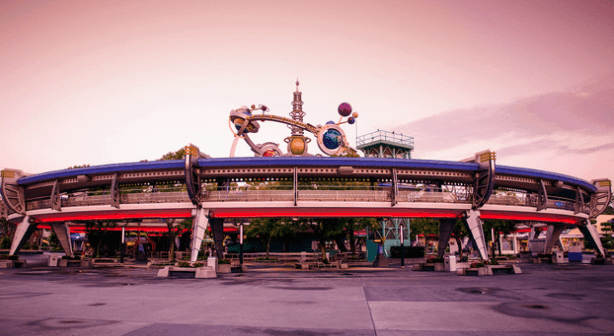
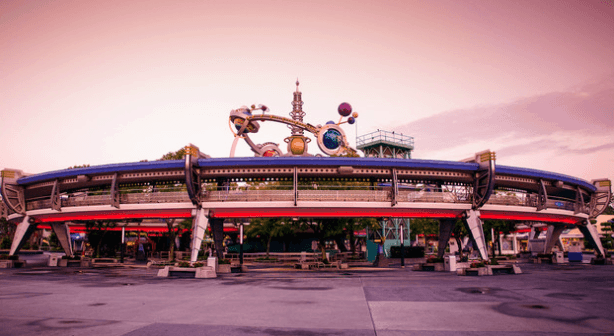
WED would again turn to this technology when developing the new Tomorrowland of 1967.  The PeopleMover offered guests a grand tour of the re-imagined land.  Guests boarded specially-designed cars that moved along the tire-powered track. (Because of the prominence of tires in the attraction, Goodyear signed to be the attraction’s sponsor.) The PeopleMover featured one major new innovation: a circular “turntable” loading area. This proved to be highly efficient, providing the attraction with a capacity of over 4,000 people per hour. Disney saw the potential of this futuristic means of transportation, going so far as to start a company to market the technologies to venues and communities (Community Transportation Services Division of Walt Disney Productions). Disney would again build a PeopleMover in Florida; however, this system would eliminate tires in favor of linear induction motors. While the PeopleMover never took hold as a means of rapid transit, it remains a fascinating remnant of a future that never was.
Video, Photos, & Review: “Working with Walt” Panel of Disney Imagineering Legends at the D23 Expo

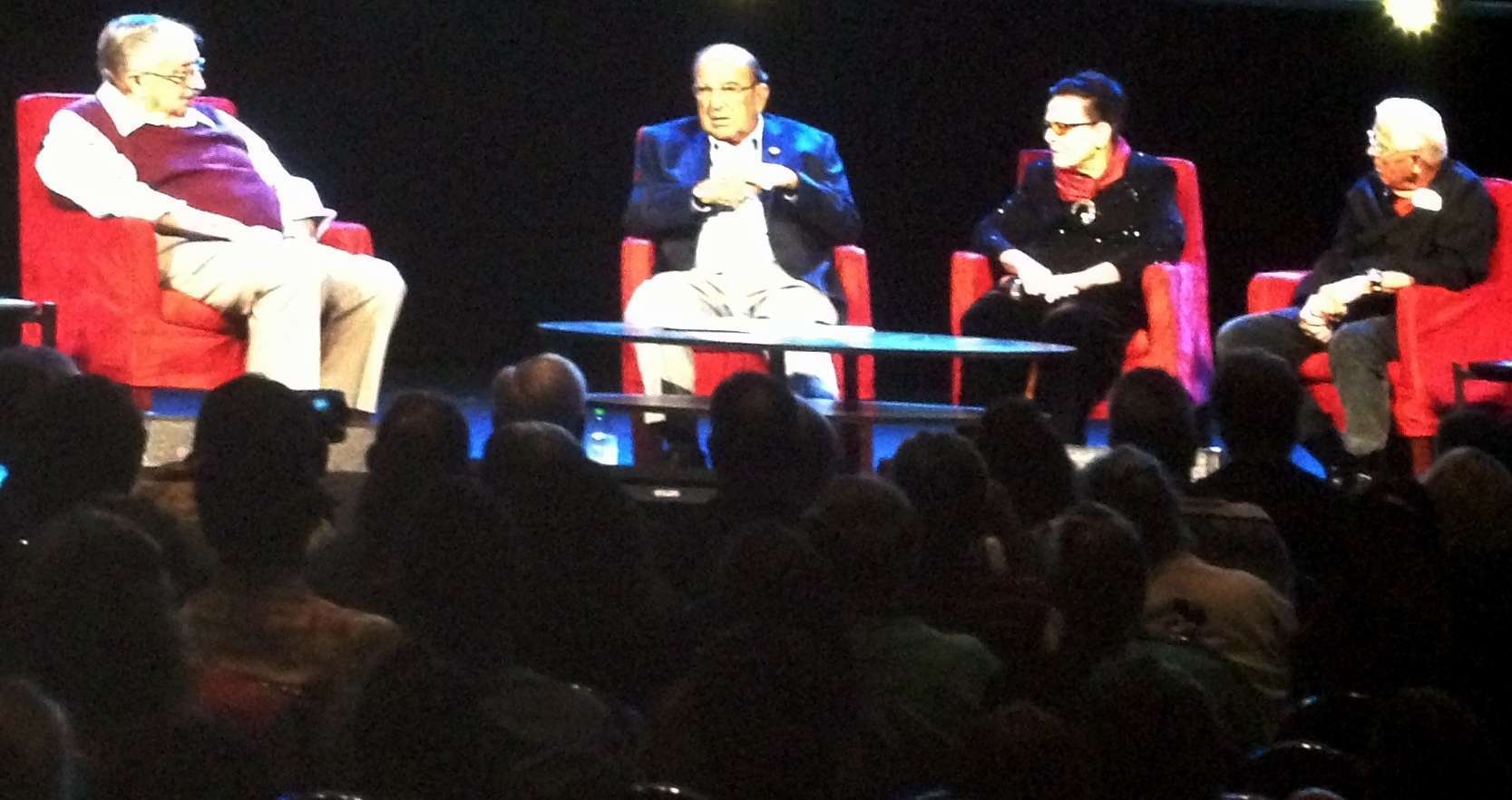
all stage

It is one of those experiences you tell your grand kids about. The time when you were in the same room as the legends who made the magic happen. I’ve had the fortune to attend a few panels over the years that included Imagineers who worked along side Walt Disney himself, to create the magic of the Disney Parks. The final day of the 2013 D23 Expo had a full slate of Imagineering panels, and it was all kicked off by a panel titled “Working with Walt.” No further explanation was needed to get me and thousands of other fans to wake up early and line up for this one.

marty stage

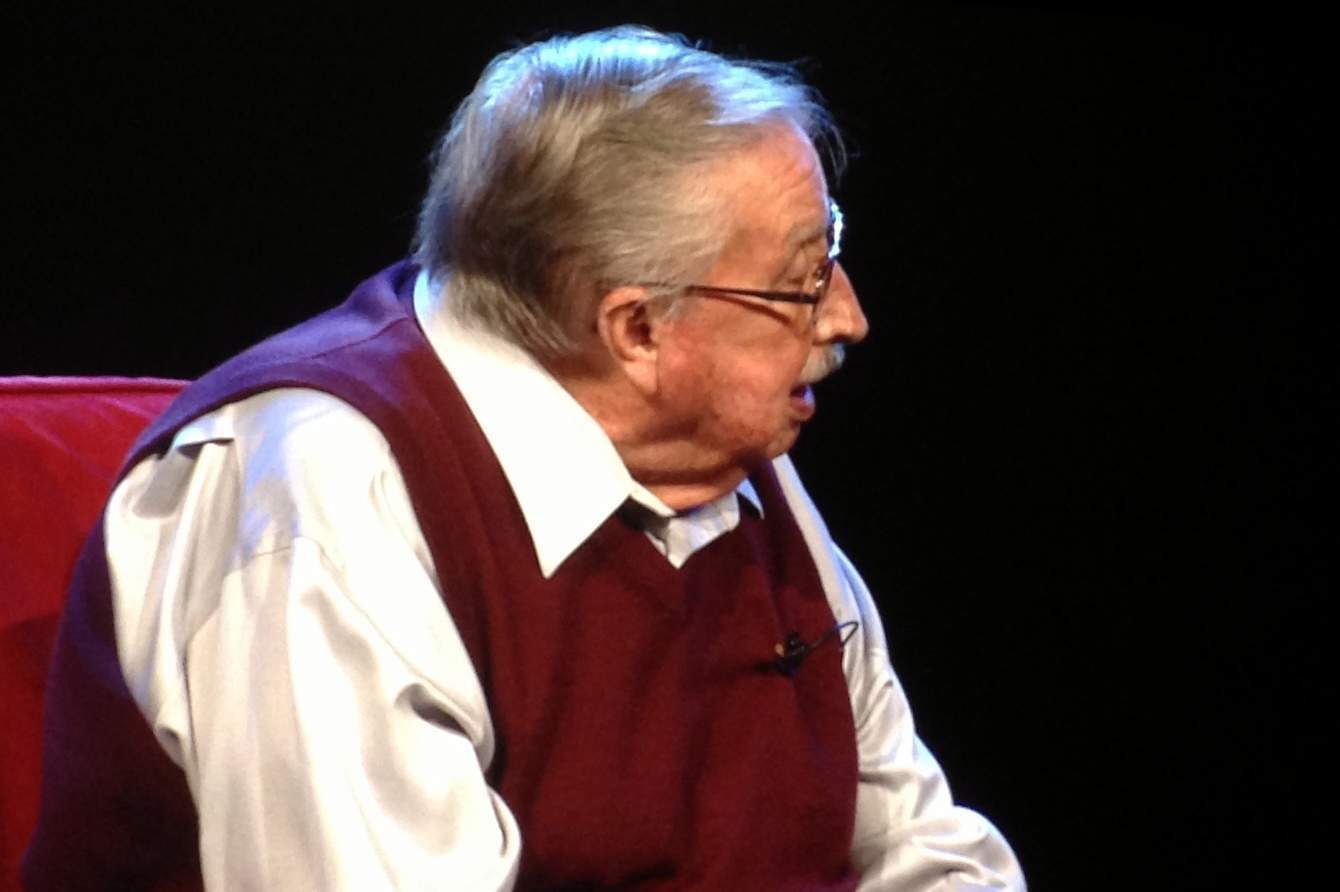
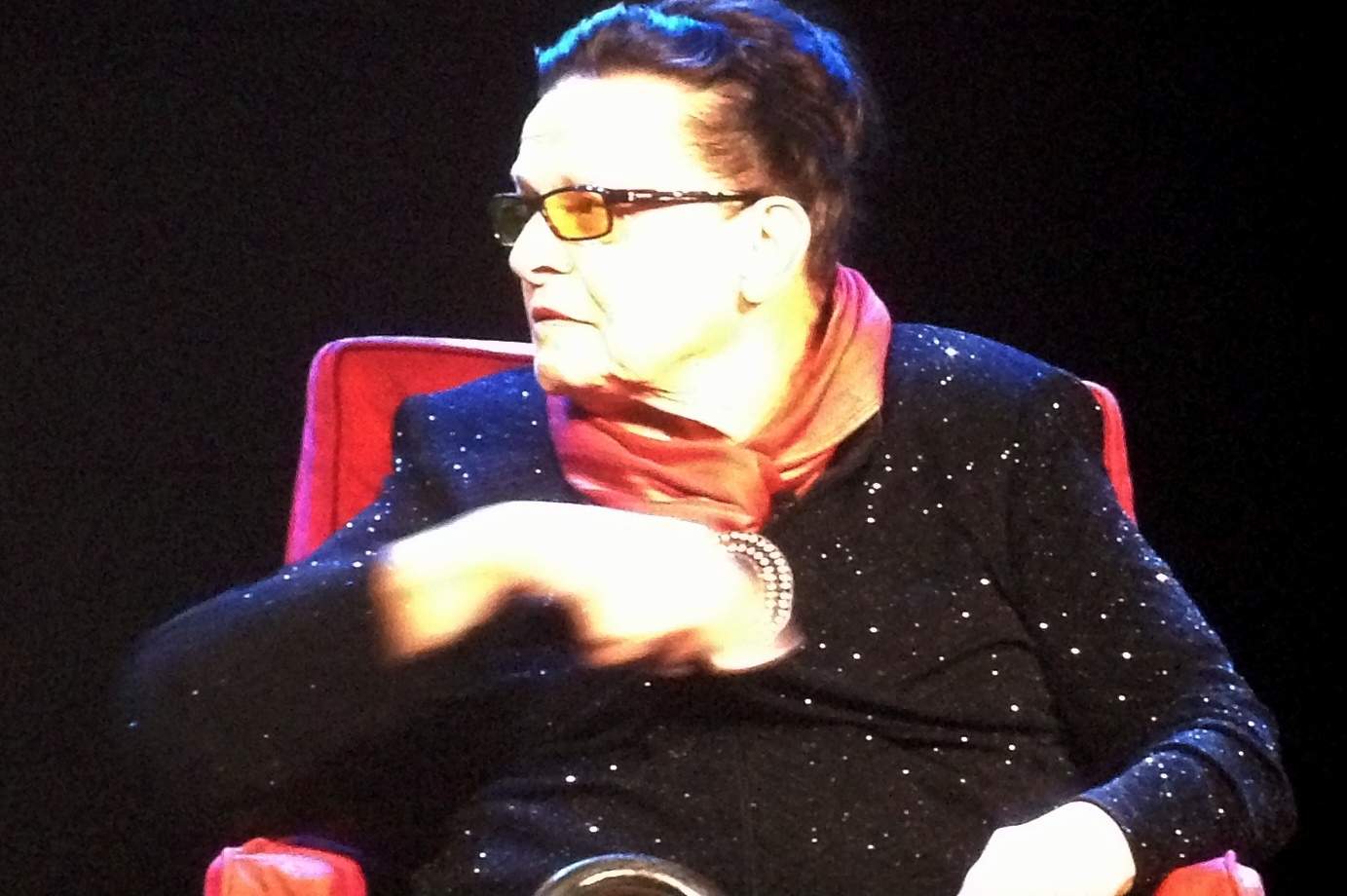
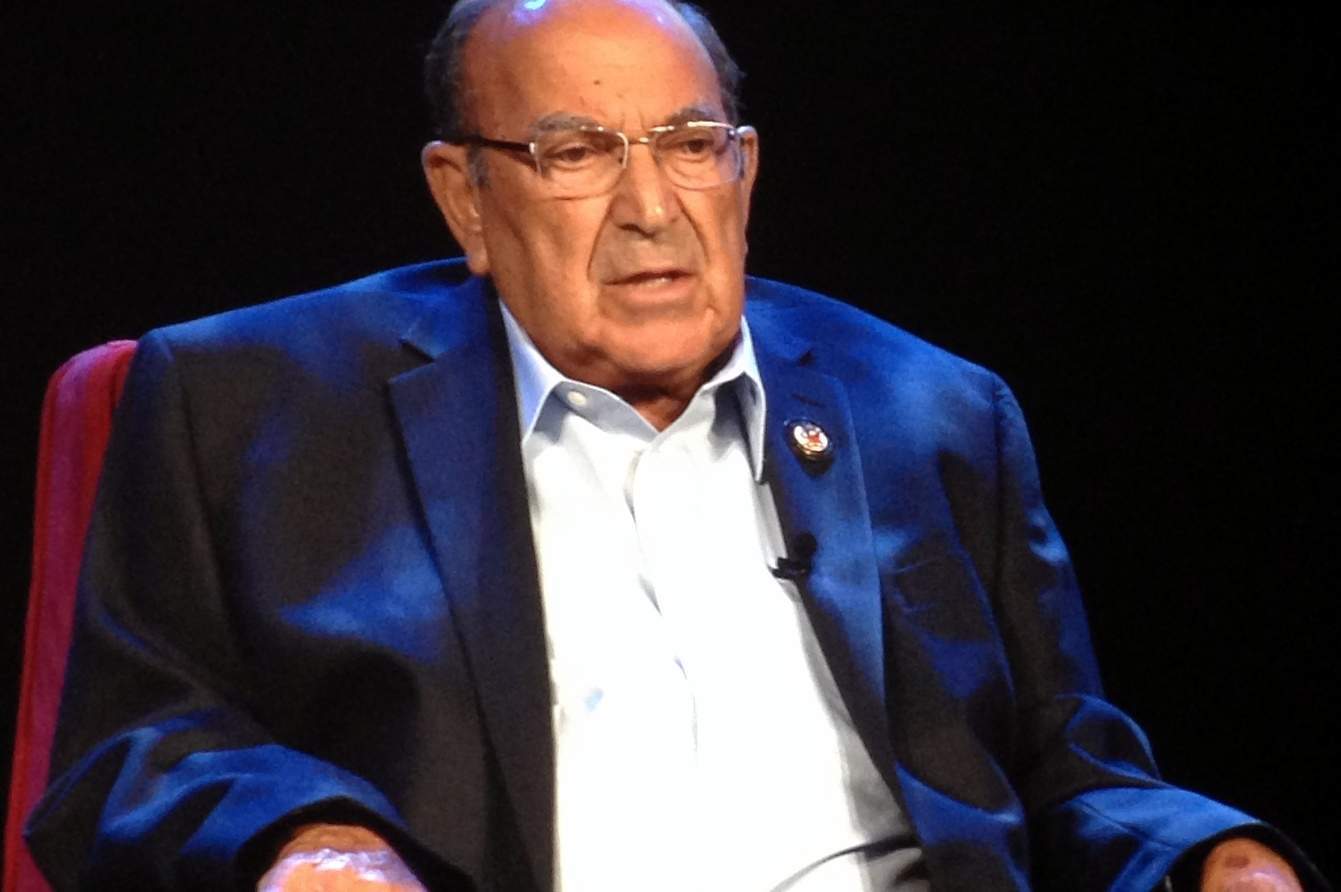
The panel was hosted by Marty Sklar and he was joined on stage by X Atencio, Alice Davis and Bob Gurr. Throughout the panel, they were asked various questions about becoming an Imagineer, their first meeting with Walt and other personal encounters with the man. Very quickly, a few things became evident. Just the process of remembering their times with WED (WDI) and Walt Disney make them light up like Spectromagic. You can tell they had such joy creating everything that brings the guests joy. There is no need to tell you what age these legends must be today, but as they sat up there on stage, their memories of Walt were as fresh as what they ate for breakfast that day. The other thing that was apparent, is they love to share these memories with all of us. So here are a few that stood out to me.

Bob Gurr (whose credits include more than 100 designs for attractions ranging from Autopia and Matterhorn Bobsleds to the Disneyland and Walt Disney World Monorails. As he’s often quipped, “If it moves on wheels at Disneyland, I probably designed it.”) told of his first encounter with Walt Disney. In October of 1964, as he was working on sketches for the new Autopia attraction, he was invited over to the back lot to take a look at the chassis of a car. As he was there, he recalled “this guy walks up. Unshaven. Looked a little on the ratty side. Had on a Roy Rogers belt with little silver bullets painted in it. And a funny little short tie with a funny little symbol on it. And he was just talking away, and then walked off. And as he walked off everybody said okay, see ya Walt. And I thought, oh my God, that’s Walt Disney. Saturday morning, unshaven… I thought that was the father of one of the night guards!”

Alice Davis (whose credits include designing and dressing animated figures for It’s a Small World and Pirates of the Caribbean) recounted her first encounter with Walt when she was called in to contribute to the 1964 World’s Fair. After the story, Marty was about to move onto the next panelist, but Alice interrupted with a touching follow up to the story. “I was born during the depression. And I didn’t have dolls like all the other little girls. I was lucky to have a roof over my head and clothes. My friends wouldn’t let me hold their dolls. So I was always sorry that I didn’t have the dolls. So when I lined up all those (Small World) dolls, and I got to do all of the costumes, I thought I’ve got more dolls than them.”

x stage2

X Atencio (whose credits include dialogue and music for Adventure Thru Inner Space, Haunted Mansion and Pirates of the Caribbean) recalled the days when Walt asked him to write the script for Pirates of the Caribbean. After the script was done, he went to Walt and suggested that a song be written for the show. He then, spontaneously sung out towards the audience “Yo, ho, yo, ho, a pirates life for me.” the audience erupted with applause. But with such pride in his work and knowing the joy he has brought millions, he had to finish the verse. “We pillage plunder, we rifle and loot. Drink up me ‘earties, yo ho. We kidnap and ravage and don’t give a hoot. Drink up me ‘earties, yo ho.”

alice stage

They all shared other general memories of Walt including the way he would lead a team of people, the fact that he always remembered a conversation and the way he cleared his throat before entering a room. That was his signal that he was coming, a trait they pointed out, that the upcoming Saving Mr. Banks movie caught onto.

The panel ended with an audience Q&A where the question was posed to Mary Sklar about EPCOT and if he ever thinks about what would have been if Walt hadn’t passed so soon. “I certainly do,” Marty replied, “Because I wrote the script for the film about EPCOT. Spending two long meetings in (Walt’s) office, just the two of us talking about what he wanted to say in that. I still have the notes. You know what, he would have made that happen. He definitely would have made that community happen. No question in my mind.”

I, and I’m sure everybody reading this, would love just a peek at those notes. And while we don’t have that, we do still have these living legends who are bursting with stories to share with all of us and we thank them so very much for letting us in.

We have a complete, uncut video of the “Working with Walt” panel to share with you today, so please enjoy:

Bob Gurr’s Main Street Shop Window

A new window is coming to Main Street! Disney Legend Bob Gurr, who was responsible for such attractions as the PeopleMover & the Monorail, will be getting his own Main Street shop window in a ceremony tomorrow morning at 8am (which is before park opening).