PHOTOS, VIDEO: Walt Disney Imagineering Unveils Prototype Sorcerer Class Bus for Disney World

While it may never see the light of day, Walt Disney Imagineering was tasked with changing Walt Disney World Resort buses for the better and created something called the Sorcerer Class transport.

The Sorcerer Class Bus, a prototype by Walt Disney Imagineering for Walt Disney World

The Sorcerer Class Bus, a prototype by Walt Disney Imagineering for Walt Disney World

The bus (displayed just for attendees of the D23 Destination D event over the weekend) looks like any Walt Disney World Resort bus on the outside, but inside guests would find special lighting, pre-recorded audio triggered by guests, and a tricked out interior design.

The Sorcerer Class Bus, a prototype by Walt Disney Imagineering for Walt Disney World

The Sorcerer Class Bus, a prototype by Walt Disney Imagineering for Walt Disney World

In theory, the automated announcer would talk guests through what they could see at their destination, but also recognize birthdays and other events on-board the motor coach through the RFID technology in the MagicBand.

The Sorcerer Class Bus, a prototype by Walt Disney Imagineering for Walt Disney World

The Sorcerer Class Bus, a prototype by Walt Disney Imagineering for Walt Disney World

With special Sorcerer Mickey Mouse themed-straps, posters with the Disney World park icons, and other decor, the bus is far more charming than the usual fare that transports guests from one place to another around the Vacation Kingdom of the World.

The Sorcerer Class Bus, a prototype by Walt Disney Imagineering for Walt Disney World

The Sorcerer Class Bus, a prototype by Walt Disney Imagineering for Walt Disney World

The lighting above is in-time to a variety of audio playing abroad the bus, best viewed in our video down below:

Again, Disney clearly stated that the busses are not in production, nor are they planned to be, but it is interesting to see that this was at least a concept. It is always said that good ideas never go away at Walt Disney Imagineering, so it is more than likely that some of the features of this transport could show up at Walt Disney World at some point in time. We will just have to wait and see…

EDITORIAL: Why Removing the Sorcerer’s Hat from Hollywood Studios is a Good Thing

Used with permission.

A fixture at Hollywood Studios since 2001. Used with permission.

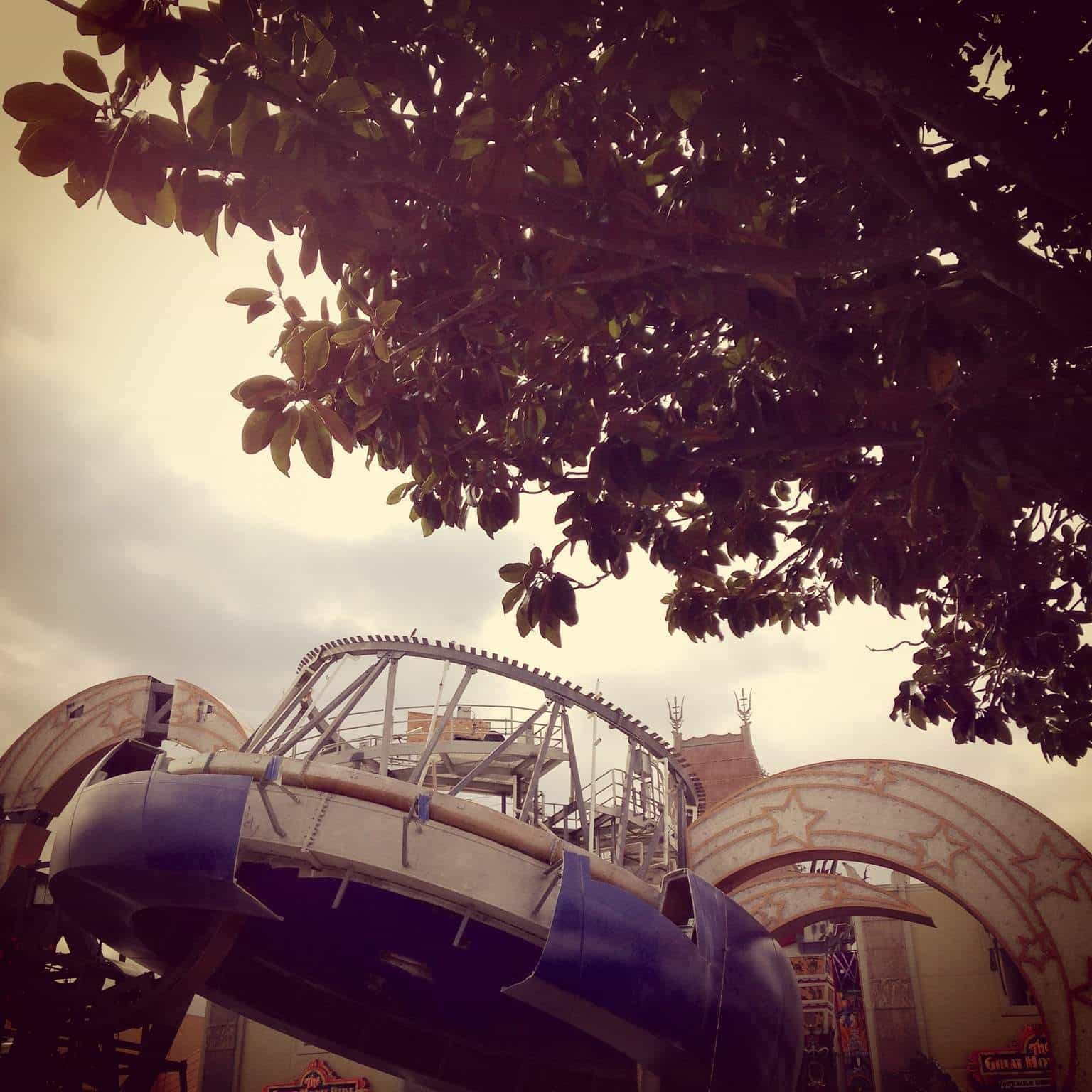
The Sorcerer’s Hat is no more. For some this is a moment of triumph and restoration. For others it represents a seismic shift in Disney’s Hollywood Studios ethos and theme. My family and I are both excited about it as well as a little sad to see such an icon of so many Disney trips say goodbye. Regardless of your personal reaction, the decision to remove the hat allows Hollywood Studios to return to its original intent and design as well as to restore the park to its more purely “imagineered” vision.

By now most of us know the story. It was 1984. Michael Eisner and Frank Wells had just accepted roles as CEO and COO of Walt Disney Productions. Early in their leadership Walt Disney World added Captain EO, Mickey’s Toontown, the Norway Pavilion, and two new resorts. To generate interest beyond Walt Disney World’s only two parks at the time, Magic Kingdom and EPCOT, plans for what was then referred to as “The Third Gate” were in motion at WDW.

According to Jeff Kurtti’s Since the World Began, plans for a third park grew out of concepts for a new EPCOT pavilion. In addition to the Norway Pavilion, Disney leaders Eisner and Wells as well as the Imagineering community had been developing a “Movie Pavilion” that would tell the story of Hollywood with a unique Disney “bent.” Once they got into the concept, however, the decision was made to abandon notions of a new pavilion within EPCOT and instead expand the idea into a new park that became MGM Studios, which became Disney’s Hollywood Studios in 2008.

The Sorcerer's Hat contributed to a very "unDisney-like" departure in thematic direction and purpose. Used with permission.

The Sorcerer’s Hat contributed to a very “unDisney-like” departure in thematic direction and purpose. Used with permission.

Thematically, this new park was created in the spirit of 1930’s and 1940’s Hollywood. This is significant because, if you’ve visited the real Hollywood, Walt Disney World’s iteration is nothing like Hollywood is now nor ever has been. Here is what Michael Eisner read from the dedication plaque on the park’s opening day:

The world you have entered was created by The Walt Disney Company and is dedicated to Hollywood—not a place on a map, but a state of mind that exists wherever people dream and wonder and imagine, a place where illusion and reality are fused by technological magic. We welcome you to a Hollywood that never was—and always will be.

The “state of mind” referenced on the plaque probably comes closest to capturing the essence of the park. I’ve heard Matt Hochberg, host of www.studioscentral.com, talk about the design of Hollywood Boulevard from the entrance to the original Studios centerpiece, Grauman’s Chinese Theatre, as a metaphorical journey from 1935 Hollywood to the present with Prime Time 50’s Cafe squarely in the middle. It’s a fascinating take on the park’s tight thematic design and Imagineering vision. And it makes sense. The net effect is this: Disney’s Hollywood Studios was created to be a representation of all Hollywood could have been, perhaps should have been, but actually has only existed in our  imagination. This vision naturally culminated in the full-scale replica of Grauman’s Chinese Theatre, which premiered Disney’s Mary Poppins in 1964. So it is with good reason that Mickey’s Sorcerer Hat was not original to MGM Studios. It was added an an attraction during 2001’s 100 Years of Magic Celebration at Walt Disney World.

Over countless trips early in my Disney park experiences I never really gave the Sorcerer’s Hat much thought. It didn’t really fit aesthetically, but it wasn’t terribly dissonant in its theming. Because “Hollywood” in my mind always implied a sense of magic, at least to a degree, the Sorcerer’s Hat felt consistent enough. It wasn’t until we were at rope drop one morning with a long, straight-down-Hollywood-Boulevard, view that I realized just how intrusive Mickey’s Sorcerer Hat was to the park described on the dedication plaque.

Hollywood Boulevard in Disney's Hollywood Studios today. Used with permission.

Hollywood Boulevard in Disney’s Hollywood Studios today. Used with permission.

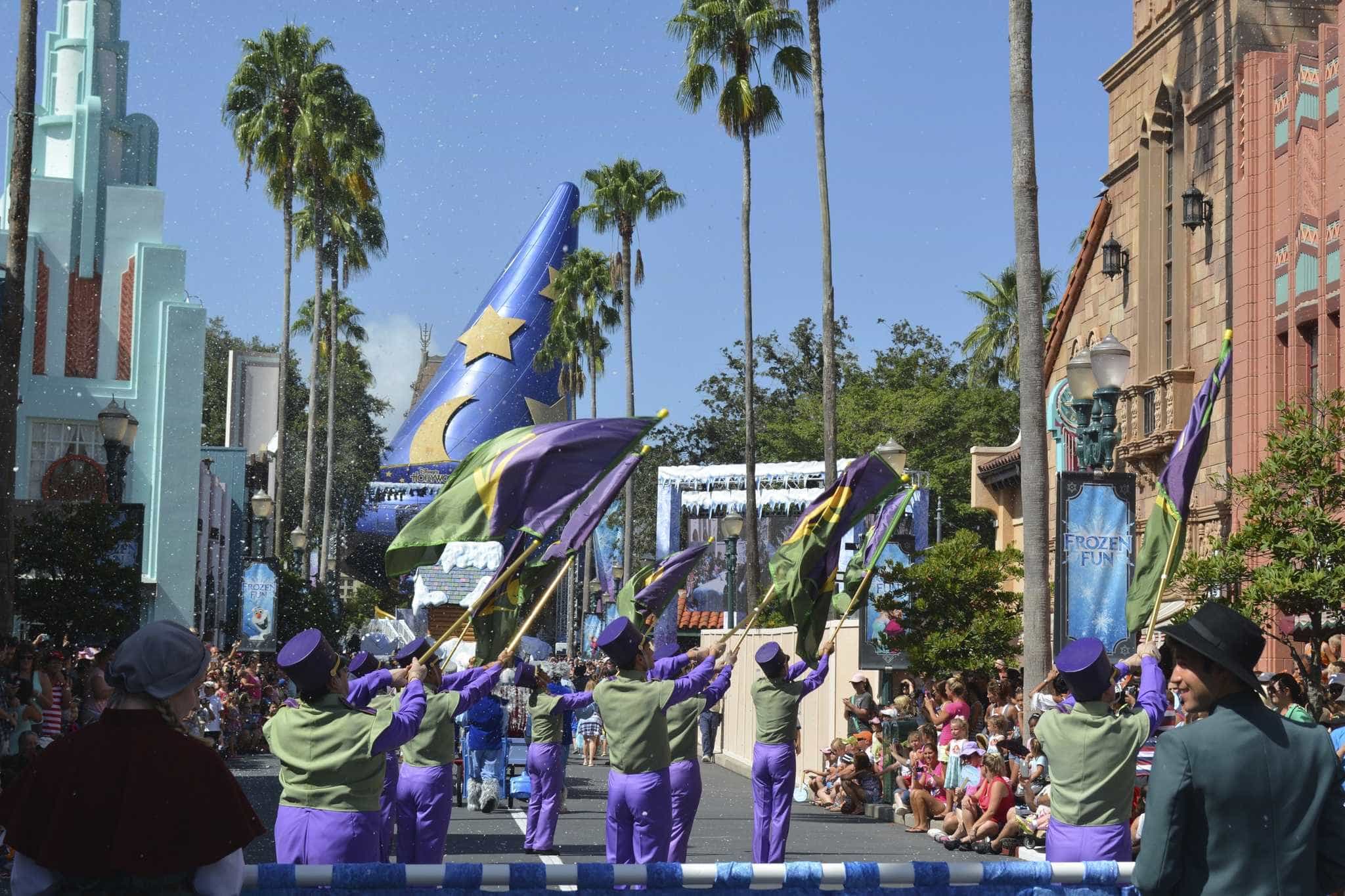
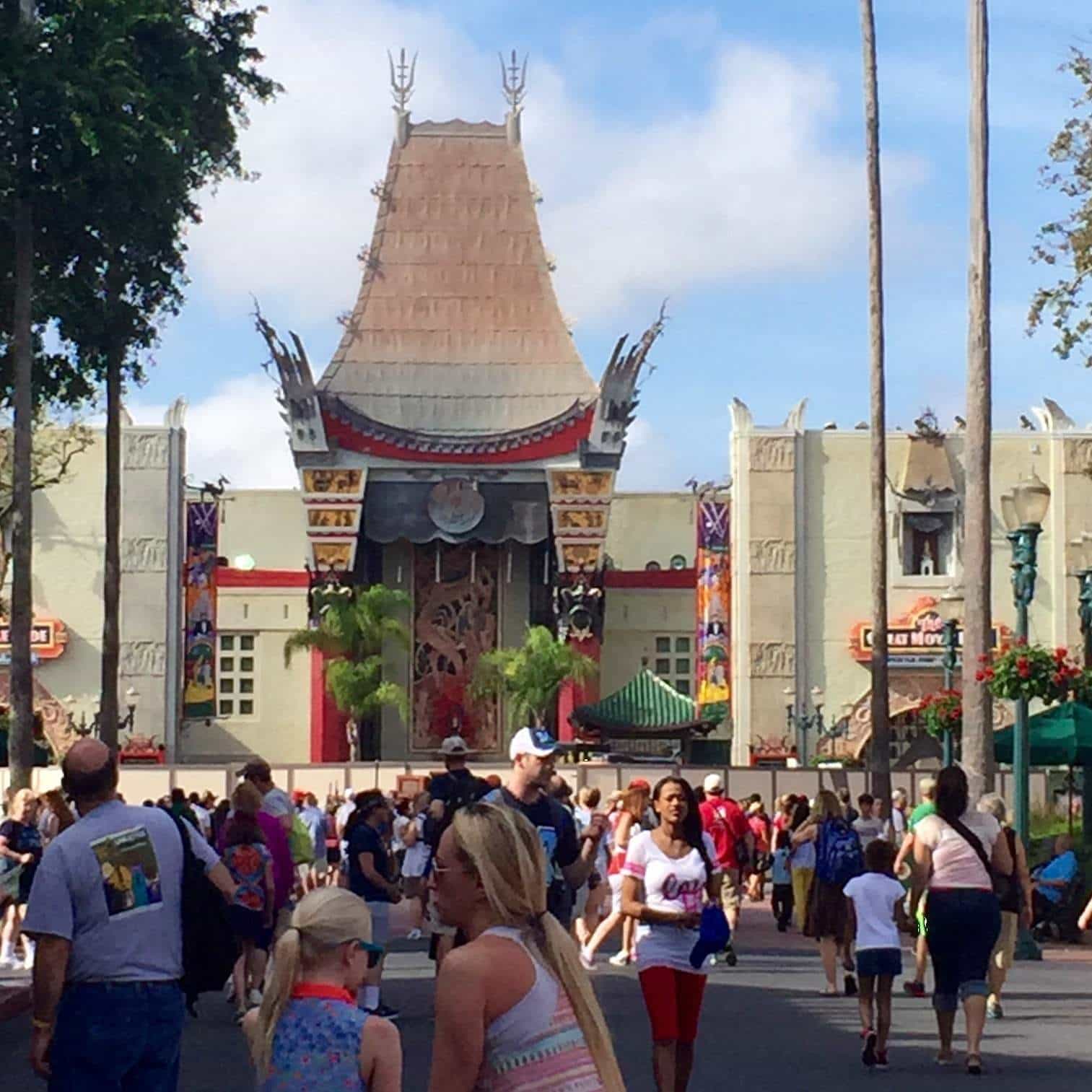
You can see in the photo above, as the Hat disappears an ever better Hollywood has emerged. Even given the size of the Hat, the impact removing one visual element from an environment is surprisingly dramatic. Similar to the recently completed work on the Magic Kingdom hub, removing the Hat really opens the area up for guests.  Grauman’s Chinese Theatre, the only structure built to full-scale on Hollywood Boulevard, is also the perfect icon for the “Golden Era” Hollywood  the Imagineers have captured. It makes everything better from the Citizens of Hollywood characters to the sense of nostalgia, and we haven’t lost Mickey’s Sorcerer Hat completely, we’ll just have to make our way to Anaheim to see one now!

Disney Stuck on the Drawing Board: Fire Mountain and Bald Mountain

Drawing-board-300x349

From past to present, and even moving into the future, the Walt Disney Company has always been making plans and changing plans. New ideas are shelved for a multitude of different reasons; either because technology is not available to make the plan work correctly, or maybe because popularity of the content material has waned–as was the case with Pixie Hollow in New Fantasyland. (The Imagineers were concerned that they could not necessarily pull off what they planned, and the lack of popularity in the Fairy films convinced Disney to walk away.) Sometimes it is a monetary issue, as with the Project Gemini plan in EPCOT. Sometimes it is just bad timing. This seems to be the reasoning behind many drawing board cases. Lets look at a drawing board case from Magic Kingdom, and no, it is not the elephant that is going to remain in the room. That might be a conversation for another day . . .

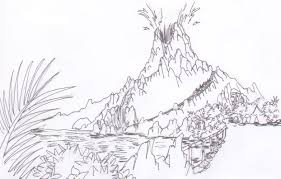
When we think about the Magic Kingdom landscape, we immediately think of the mountains: Splash, Space, and Big Thunder. The rising Zip-A-Dee-Doo-Da from Brer Rabbit and Brer Bear, to the sound of a locomotive running wildly out of control, Frontierland bustles with traffic of guests to two of the three mountains. In Tomorrowland, the aura of white spires and a clean mountain draws guests into Starport 75. We can only imagine what MK’s mountain range could have been if Disney followed through with plans to add Fire Mountain and Bald Mountain in the mid 1990s.

When 20,000 Leagues Under the Sea was being closed and eventually removed, there were plans to add not one but two mountains as a way to ease guests disappointment over the closing of this famous E-ticket attraction. Both of these attractions were similar, but it is said that Michael Eisner loved the ideas so much he wanted both to be built within the MK walls. Each mountain was going to  its own land: Fire Mountain to be placed in Adventureland, and Bald Mountain where the old Leagues attraction lay dormant. Sadly, neither of these mountains were ever built.

firemountain

Fire Mountain was to be located either between Pirates of the Caribbean and Splash, or directly on the other side of Pirates (though that would have taken some refurbishment of the Jungle Cruise to achieve) and would have been the so-called “weenie” that drew guests deeper into Adventureland. This attraction was rumored to be a combination of a standard roller coaster and a flying roller coaster, which meant at one point the ride would change from a track below guests to a track above, and the vehicles would have guests lying facedown in an attempt to mimic flying like a bird (or certain Marvel characters). The mountain would be a gigantic volcano, fitting right in with Adventureland’s story. Guests would fly and soar through and around the volcano with molten lava and dark and scary theme. There was an idea Fire Mountain would be the beginning of an expanded area of Adventureland. As costs soared, the decision was made to make it only a flying coaster– and then sadly, Fire Mountain was completely shelved.

32859-bald_mountain

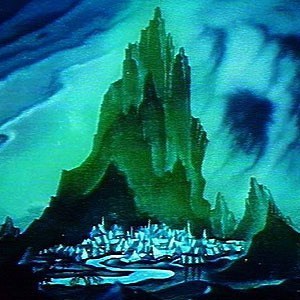
Bald Mountain, from Fantasia fame, was to have been built near or on the exact spot as the 20,000 Leagues Under the Sea. To draw guests to this portion of the park, the attraction would house a log flume, or roller coaster (or a combination of both, which was never decided) themed on Disney villains. Also known as Villains Mountain, this attraction would take guests through a hair-raising experience of escaping from some of Disney’s most famous evil characters. As a log flume, guests would have boarded longboat-style rafts modeled after Hades’ boats in Hercules. Guests would have been taken through Chernabog’s mountain, where the villains were meeting to decide who was the most evil, and how to take over the Magic Kingdom. Suddenly, guests would be “attacked” by a combination of Disney villains, saved only by a slide deep down the plunge in the front of the mountain (the roller coaster theme never had a major story design, leading many to believe that a flume ride would have been the choice here). By combining the roller coaster idea with the log flume, Imagineers were possibly ready to attempt a difficult concept that took almost five more years to actually happen, albeit in another resort.

Why do we visit Magic Kingdom and not see either of these attractions? The answer is not so simple. Disney thought they had two can’t-miss attractions, and went as far as toying with the idea of making an expansion to Fantasyland based around villains. As this concept became a bigger, rumor of a fifth gate based on villains also began to be discussed and gained steam. This made the Bald Mountain concept too valuable to construct in Magic Kingdom, especially if it would be added to the rumored fifth gate. Alas, the villains park has yet to go anywhere, and with the Fantasyland expansion near completion, it is doubtful Magic Kingdom will ever see Bald Mountain. As for Fire Mountain, plans were set for construction, with Disney even floating a balloon high to the peak of where the mountain would be to test if it would be visible from Main Street USA (it was not, but it was clear as day to the Polynesian Resort.) It is believed that WDW management saw the huge expense of building a major roller coaster in a family-oriented park and decided against it. Will we one day see one of these attractions high above Magic Kingdom or another Disney park? It is possible. Let’s keep an eye out to the future and what may happen. You never know when old plans become new again!

Disney Stuck on the Drawing Board: Project Gemini

When we look at the Disney Resorts around the world, it is sometimes hard to wonder what might have been. What could we have seen in the late 1990s other than an empty 20,000 Leagues Lagoon? How different might Sunset Boulevard look if all of the aspects of the Disney Decade came true? Oftentimes Disney guests hear a little piece of the story, or none of the story, leaving rumors to abound and speculation to ensue. In the coming months, my Stuck on the Drawing Board series intends to dig into the facts about these plans, and why stayed on the drawing board.

photo-35-X2

Project Gemini

In the early 2000s, the Walt Disney Company began looking into ways to revitalize a few of the parks that were either under-performing, had not aged extremely well, or weren’t succeeding with guests. One such park that was moved toward the front of this list was EPCOT. Looking at the park as a whole in the 2000s, a few things stand out: The Living Seas had not yet had any major refurbishment; Horizons had just closed and was in the process of being demolished and replaced by Mission:Space; and the Wonders of Life Pavilion was still operating, but soon to be reduced to seasonal operation. There was a definite need for a major overhaul of Future World– but what?

The simple refurbishment of Future World turned into a major overhaul, complete with a name that would befit even Walt Disney himself: Project Gemini. This concept would completely revitalize the area of Future World, and bring it back to the original edutainment concept for the park. Guests would immediately notice a change in the signage and the overall theme of the land. The Future World name would be replaced with Discoveryland. Imagineering believed that the name Future World placed immense pressure on them to keep coming up with concepts, attractions and technology that was believed to be futuristic. With a name change, Imagineers thought there would be less pressure on them to continue pushing the envelope.

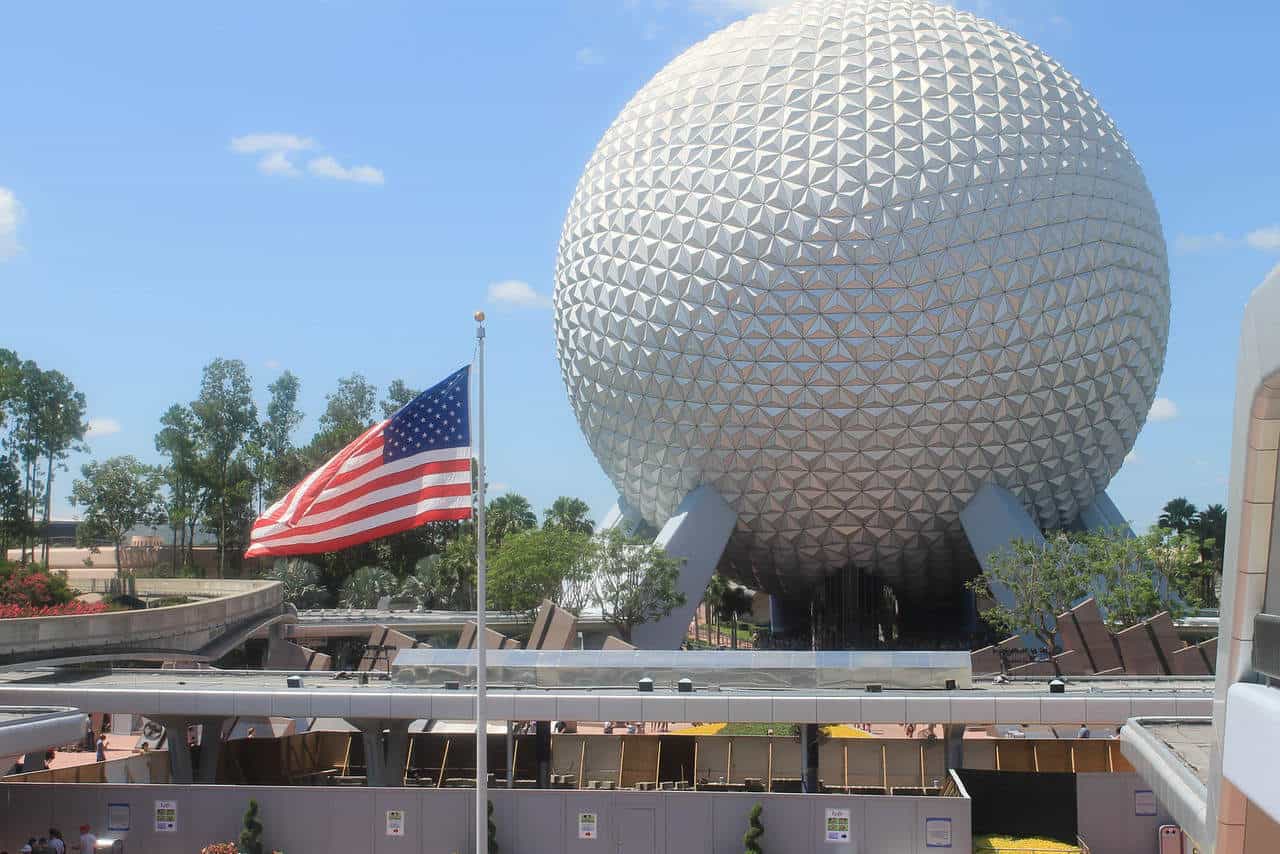
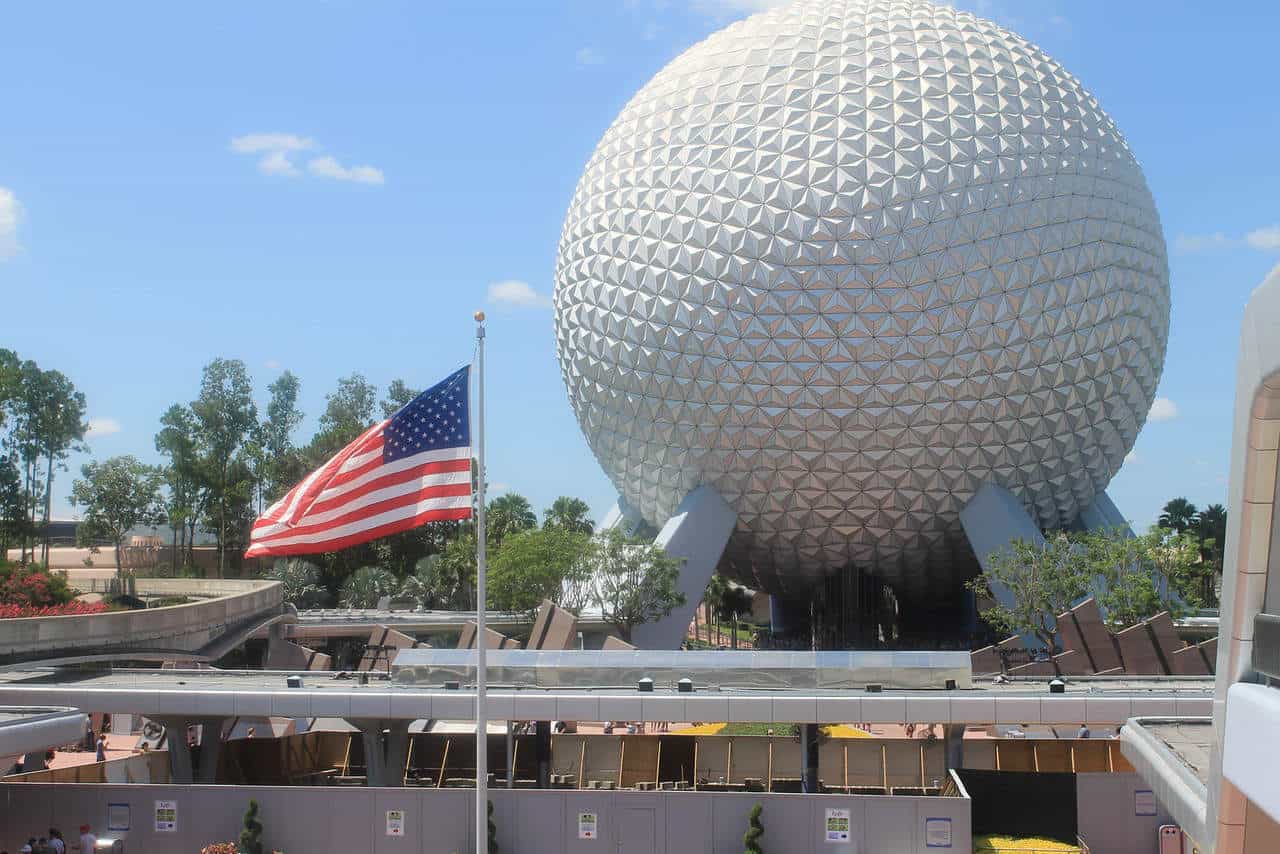
As soon as you walked into EPCOT, you would immediately see the change in the land: trees and shrubbery would replace the vast openness that the park has been known for (as well as the heat exhaustion from lack of shade). The first noticeable change in the setup of the land would be the inability to walk by Spaceship Earth on the left side. This was because of an addition that Imagineers called Time Racers.

Time Racers was to be a thrill ride located within the Spaceship Earth geosphere, based on the theme of time travel. The attraction, sponsored by Microsoft, would essentially be a dark roller coaster attraction with projection screens whizzing past guests. At the time, the former AT&T Global Neighborhood post-show would remain, but that could be due to the lack of a completed plan for the attraction. The closing of the left side walkway of Spaceship Earth was due to the addition of a pre-show and queue lines that would be indoors. Time Racers would essentially spell the end of the iconic omnimover dark ride made famous by Walter Kronkite and Jeremy Irons.

The Discoveryland plan continued with Living Seas being refurbished and themed around The Little Mermaid. This concept seemingly had a place within the pavilion, what with its connection to the sea and its immense popularity even in the mid 2000s. There was also a plan to close and refurbish the Imagination Pavilion to fit the project’s new theme. This was another in a long line of plans for refurbishment that never truly made it past early planning.

One of the more solid plans that was a Junior Autopia in front of Test Track, update the theme of Test Track itself, and add Soarin’ to the park in a pavilion built between the Land and the Living Seas. Soarin’ would have a Florida-themed film. The Innoventions buildings would have been broken up into six different buildings. On one side would be a building themed around expanding technology called Leading Edge,  a futuristic restaurant (likely where Electric Umbrella is), and a “future mart” which would replace MouseGear. The other side would feature an Internet cafe, a location for buying futuristic consumer goods, and a “house of the future.” These plans would have seen structural changes as well as pathway changes–much of what we see today surrounding the Fountain of Nations would be redesigned.

What happened to this plan? Why is it not in place today? The answer is money. Money became a serious issue. Rumors persist that after the Project Gemini concept was pitched, it was shot down quickly and sent back to the drawing board with the directions to cut costs. It seems the most expensive piece to the project lied in the redesigned Spaceship Earth, and many Imagineers even wondered if the structure could hold the weight and torque of a roller coaster. Also, there was the issue of logistics– it would be difficult to move construction into the geosphere.

So, in the end, the only piece  of Project Gemini that EPCOT received was Soarin’. The attraction was cloned and placed within the Land Pavilion. It did not get its own pavilion, nor did it receive a Florida-themed film. Siemens became the sponsor of Spaceship Earth, not Microsoft, and the attraction stayed somewhat the same, with only minor changes. The Living Seas received a Finding Nemo update, not Little Mermaid, and Innoventions stayed the same. The Imagination Pavilion is scheduled for refurbishment in early 2014, and many believe that some type of Phineas and Ferb attraction will be added.

Though Project Gemini stayed mostly on the drawing board, it is good to look back at this planned-but-never-created idea. Though it may be in the archives, we may never know when Project Gemini, or pieces of it, could come out of the archives.

Walt Disney Imagineering D23 Series Review

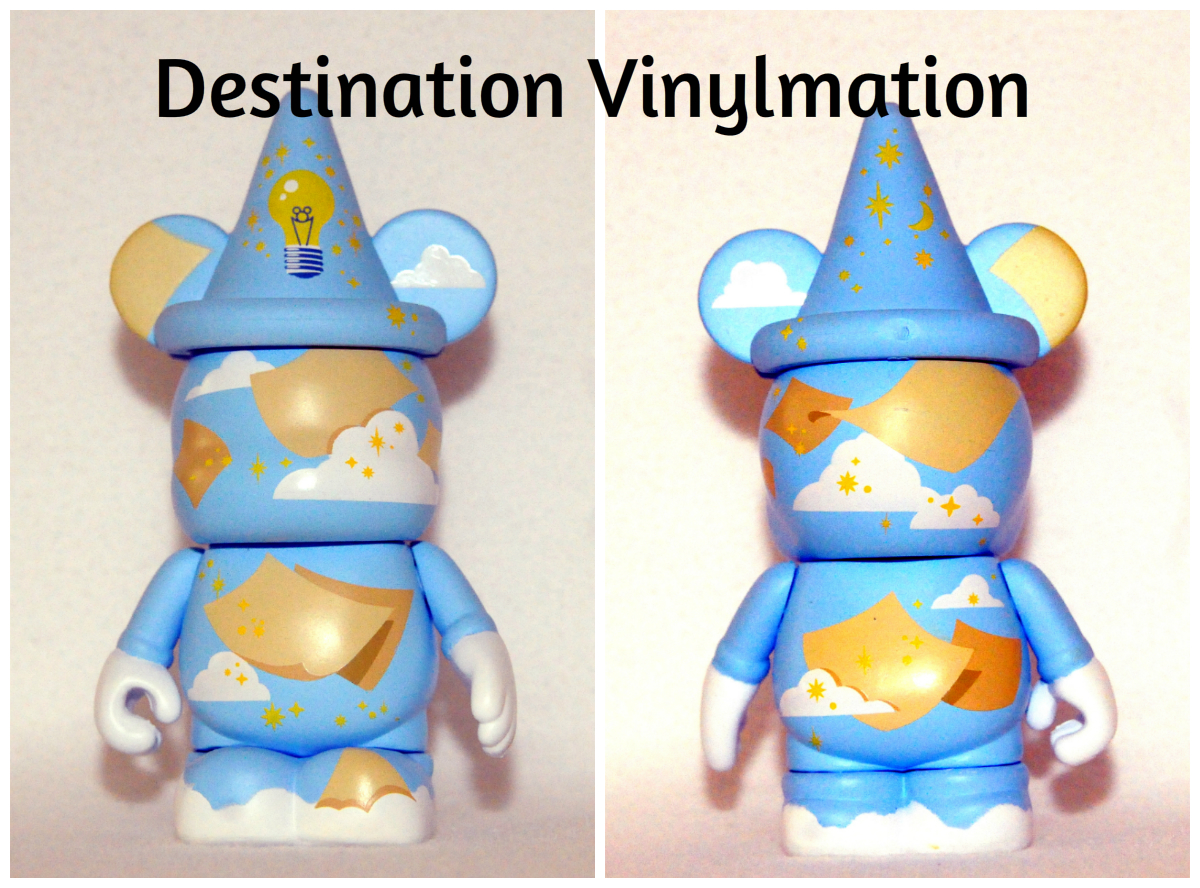
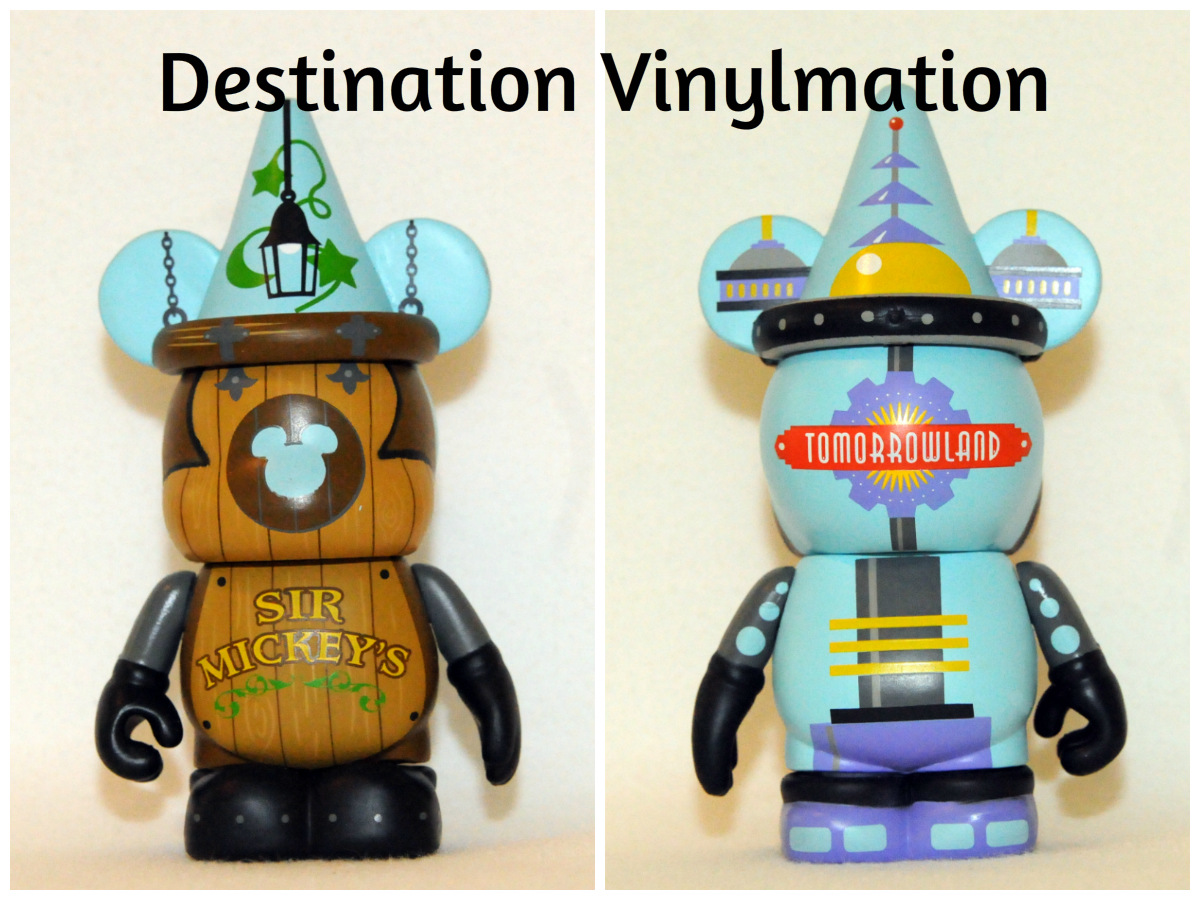
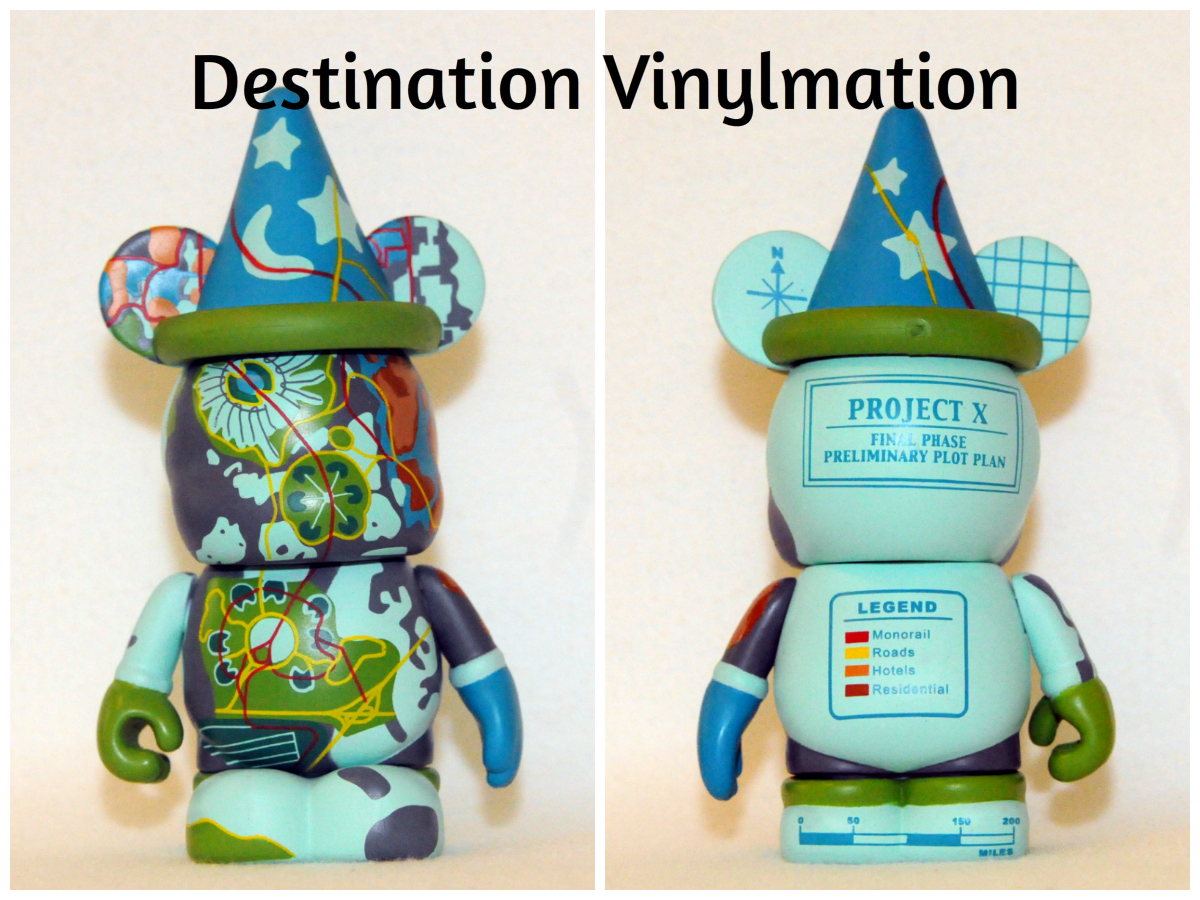
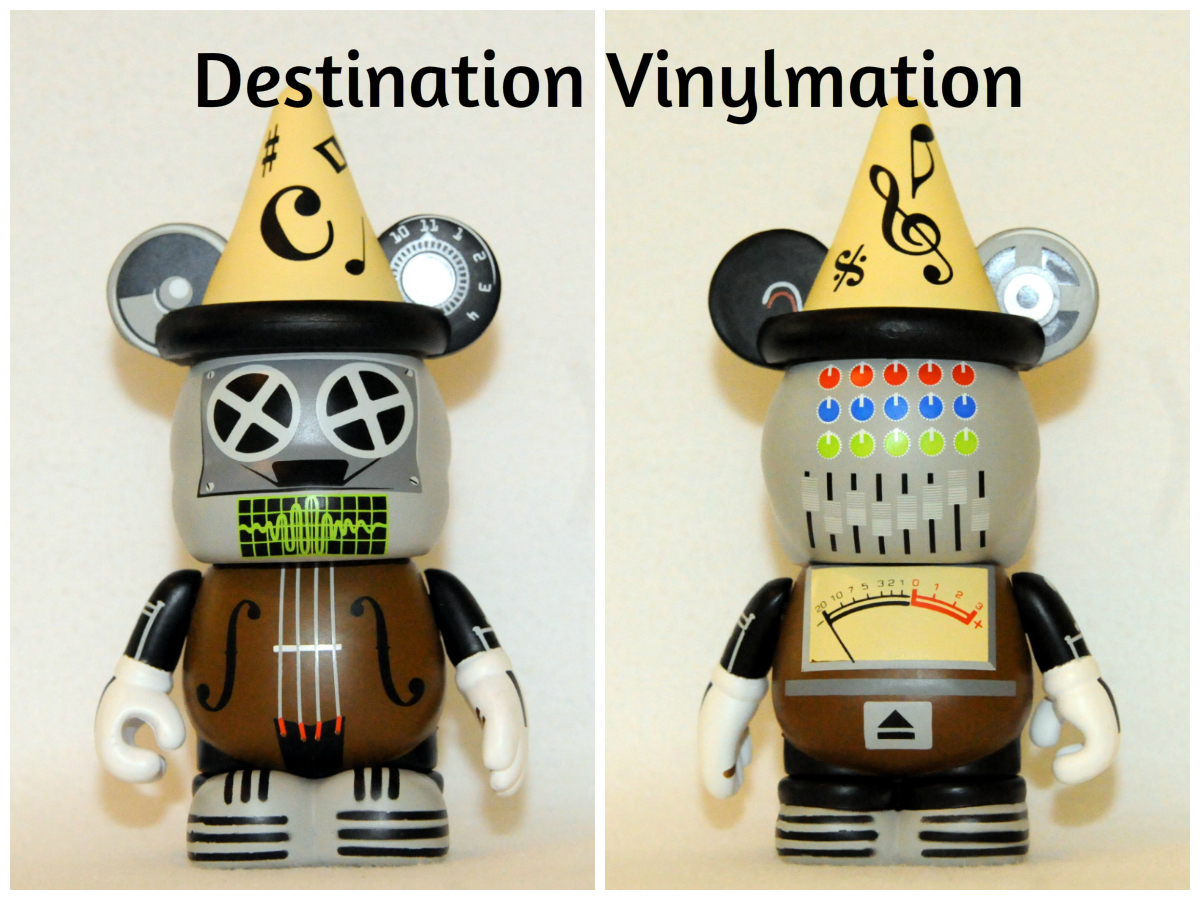
In the world of Vinylmation, where set after set is pumped out of the factory at ever alarming rates, some designs blur into the background and much of the art and ideas start to look similar. Sure, different artists have their own style and after seeing a few dozen you have a good idea who did what. But every once in a while, a figure or series takes a leap forward and jumps out from the pack. The Walt Disney Imagineering series that was released at the D23 Expo is one of those sets. WDI Graphic Designers David Buckley and Justin Hamana have given us a fresh take on a produced Vinylmation figure. They pushed the boundaries, were innovative and took risks that we don’t often see these days from the Disney Design Group. Don’t get me wrong, that takes nothing away from the DDG artists. I still think they produce some amazing artwork. But introducing some new hands into the design mix is never a bad thing. The WDI series is what the Park series seemed to used to be. There are so many hidden details in here, that I don’t even notice them all until the fifth or sixth look. In my opinion, this is the series of the year.

The Imagineering series was released at the 2013 D23 Expo inside the WDI Mickey’s of Glendale shop. It is an open window set of 8 figures sold separately for $14.95 each. Each figure has an edition size of 1000. Originally, eight different Imagineers were going to each design a single figure. But somewhere in the process the entire series was put on the shoulders of WDI Graphic Designers David Buckley and Justin Hamana. David contributed 5 designs while Justin handled 3. With Sorcerer Mickey being the logo of WDI, each of the eight figures has the Sorcerer hat accessory. Let’s take a closer look at each design. (audio review available in DV Podcast Ep. 131)

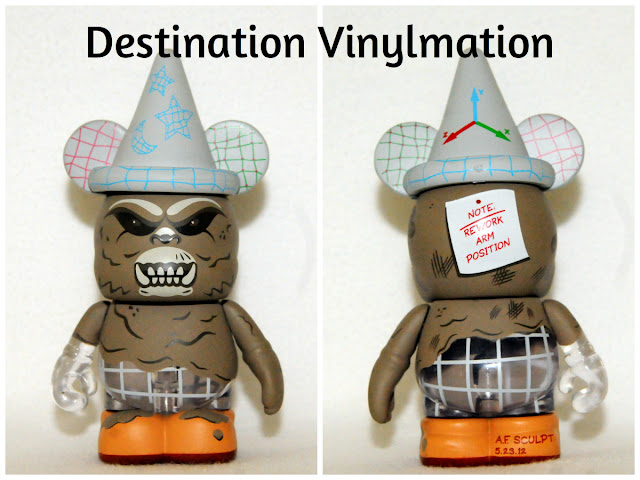
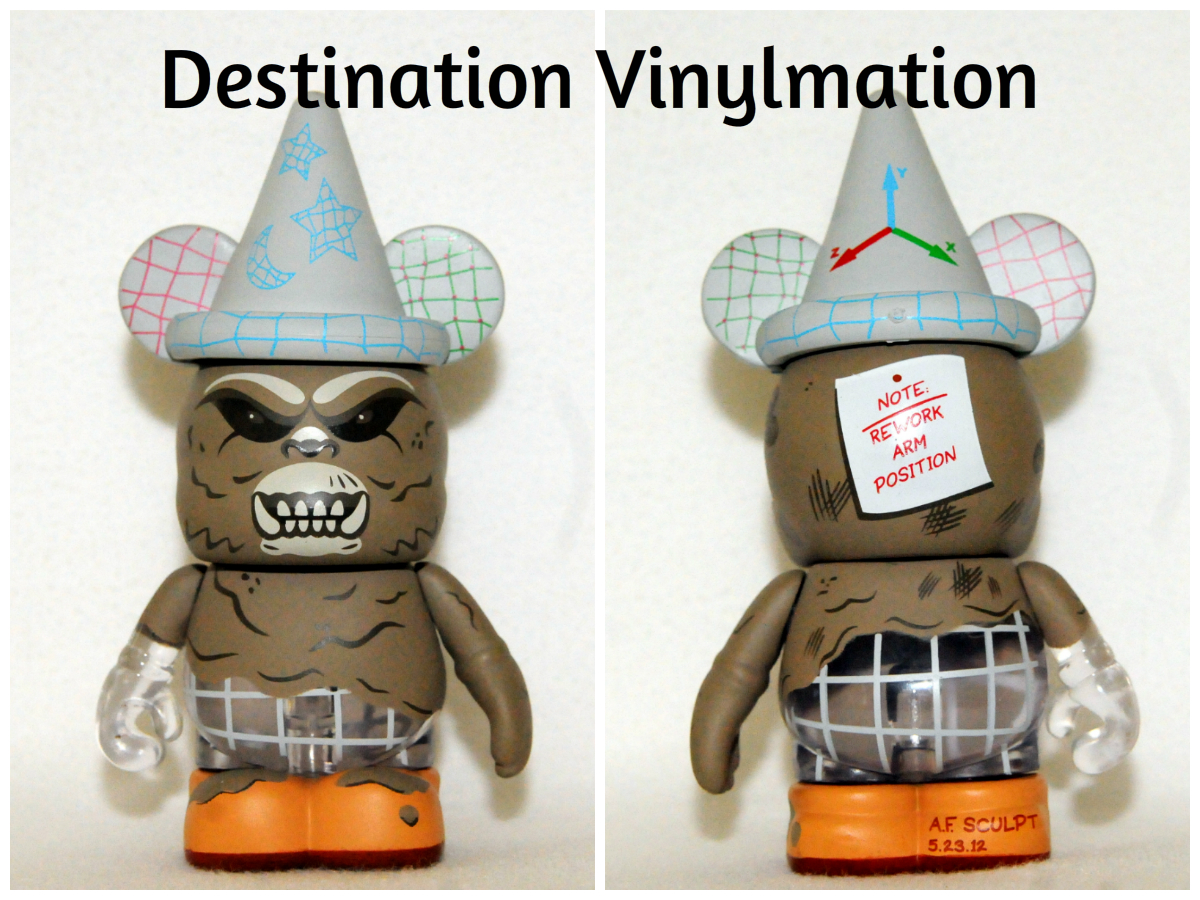
David Buckley’s “3D Design/Sculpting” figure features the Yeti from Everest being sculpted in the body. The clay is wavy and uneven and is spread over a mesh frame. The use of clear to show the unfinished part of the sculpture is nothing short of perfect.

The feet represent the table. On the back, the table has some writing and there is a hilarious note attached to the body, “Note: Rework Arm Position,” no doubt a reference to the broken Yeti arm inside the mountain. The hat features graph like lines and points that represent 3D Design on a computer.

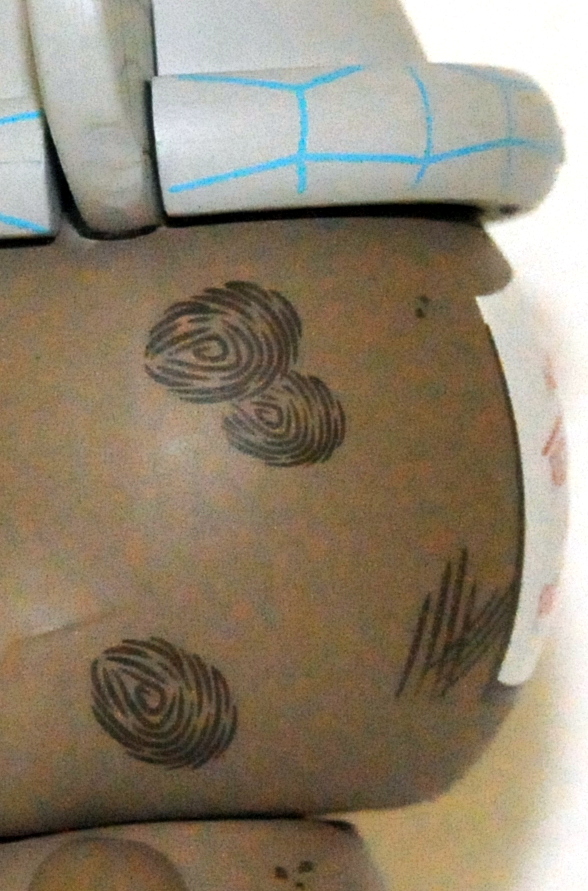
All those details make this a wonderful piece, but the finger prints in the clay on the side are a remarkable touch.

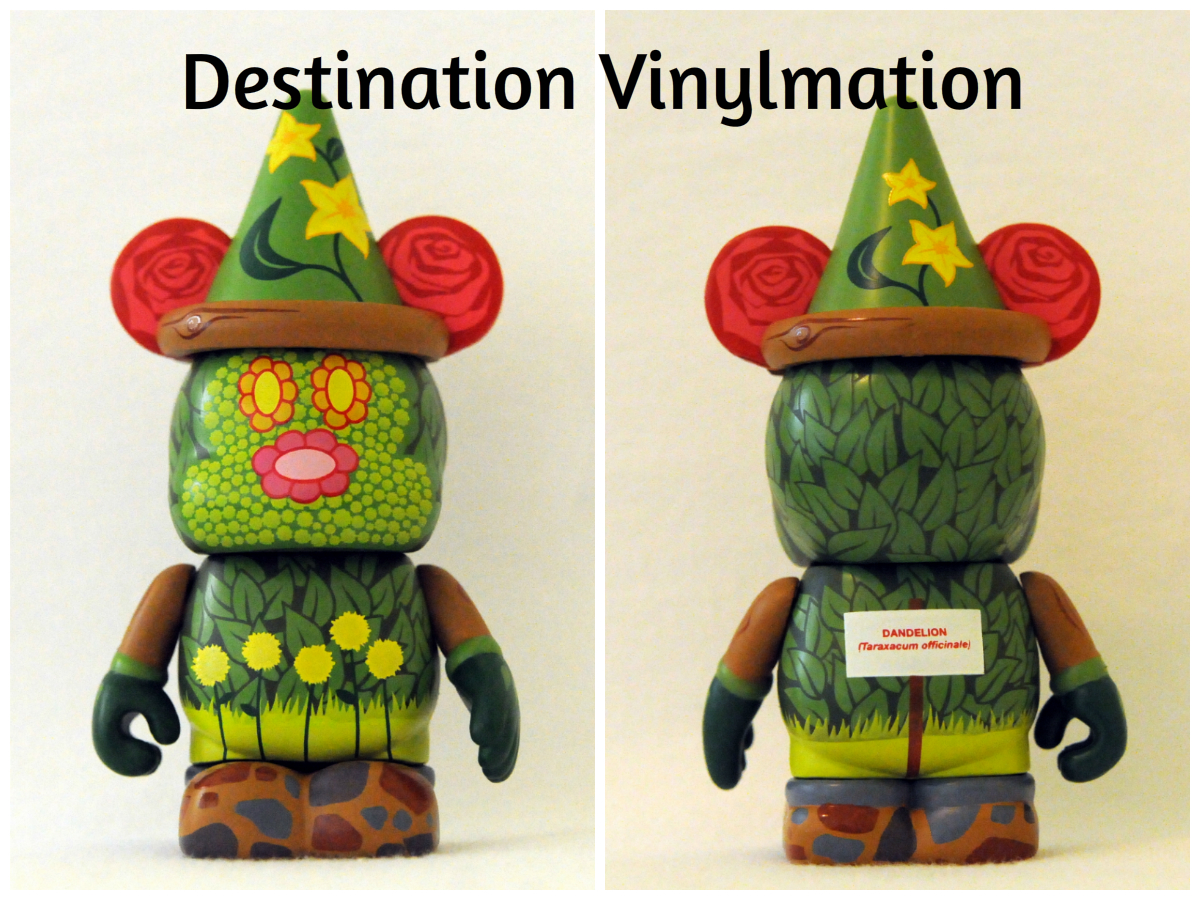
“Landscaping” is an interesting design in that it could be rather boring, but the attention to detail by David raise this one up the ladder to one of the series standouts.

Just the fact that no part of the canvas was left unused. Roses in the ears, cobblestone in the feet, a Mickey face flower design in the head and flowers and leaves all over the place. But again, it is the hidden touch that makes the design. The sorcerer hat has stars and moons shaped out of flowers and leaves!

After opening figure after figure and seeing all the hidden objects on the back, “Blue Sky” was almost a let down. I say almost, because it still is a remarkably pleasing design by David Buckley that holds a lot of meaning to Disney Parks fans.

The same design elements are carried from front to back, but the charm is in the light bulb. The filament is a Hidden Mickey.

The figure that most showcases the talents of these two graphic designers is of course the one titled “Graphic Design.” David used the front to showcase the Sir Mickey’s sign that hangs in Fantasyland at the Magic Kingdom. The back features the familiar Magic Kingdom Tomorrowland logo.

All the colors and fonts are spot on. Again the hat holds much of the magic with the stars and moons being made of vines and leaves on the front.

In my opinion, the best figure in this series and one of the greatest Vinylmation designs created to date is the ambitious “Master Planning” design. David was worried this wouldn’t be read to well because there is so much going on here. But it is laid out so well, any Disney Parks fan would instantly recognize it as the original map layout for Project X, or what would become Walt Disney World.

This is a masterpiece, with all the buildings, roads, monorail tracks and bodies of water depicted. The back has a scale in the feet, legend in the body and a graph and compass in the ears. Perfection.

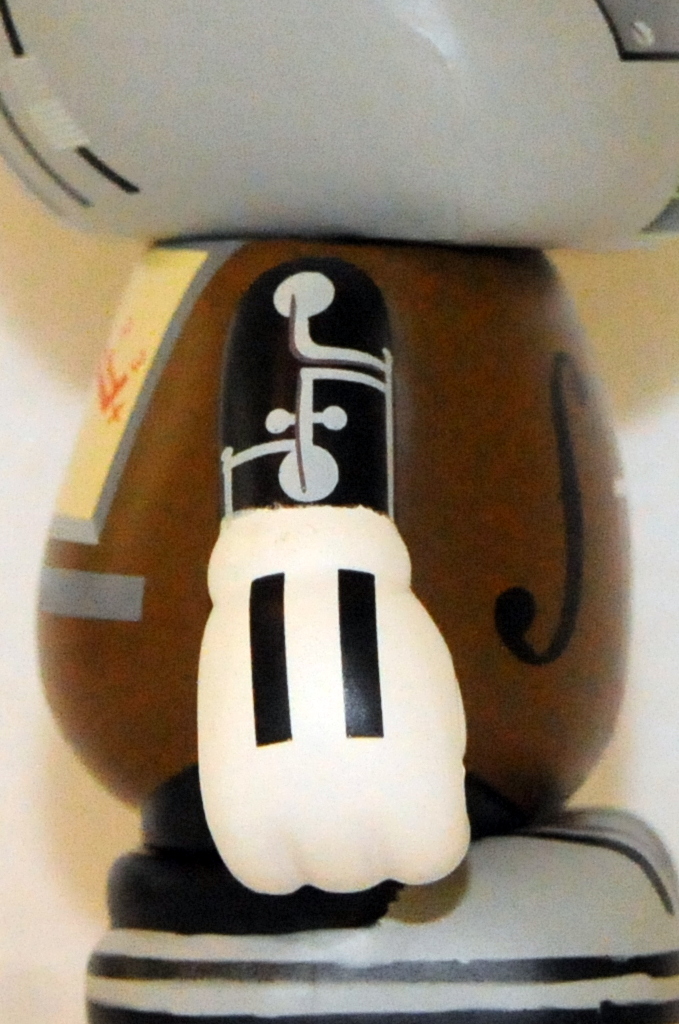
Justin Hamana packed a ton into the “Music” figure… including a non-Disney reference he was very proud of. The front has a reel to reel tape deck, audio waves and violin body. The back has audio mixer faders and knobs, a volume meter and eject button.

The ears have a reel, audio wires, what looks like a CD and a volume knob that goes to 11… a Spinal Tap reference. The hat is full of music notes and the hands have piano keys.

Wow, talk about using every inch of the canvas. This is why I get upset when I see completely white or blank ears.

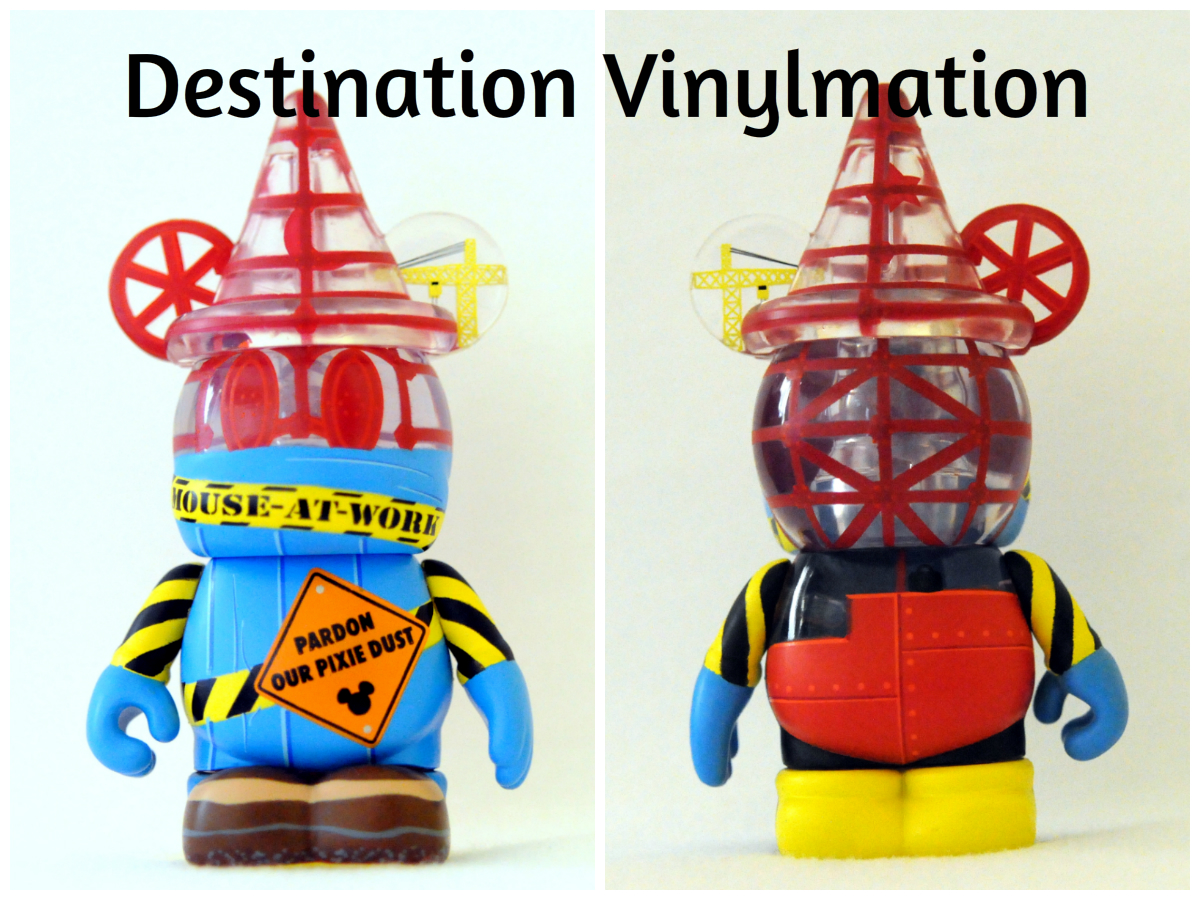
“Construction” has a lot of little ideas present as well. Justin used clear well here to demonstrate the structure of a building rising above a blue wall. We see the familiar yellow caution tape that reads “Mouse at Work” and the wonderful “Pardon Our Pixie Dust” sign.

The feet blow me away. It looks to me like the various ground levels. I see sand, dirt and water table levels. There is a tiny, detailed crane drawn into the left ear and there is a lunch box on the structure on the back. A nice touch indeed.

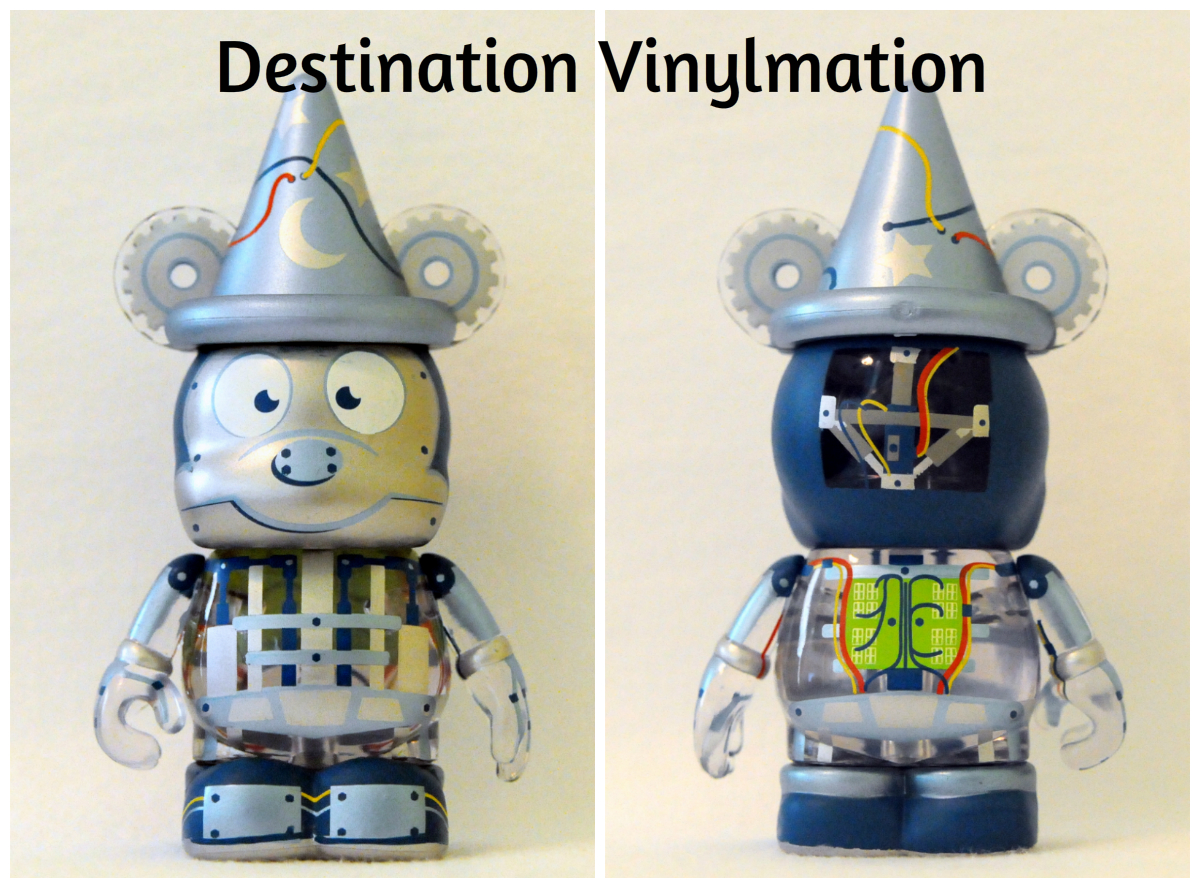
The final figure is “Audio Animatronics.” This is probably the weakest design in a very strong set. It pains me to say that about this one because it is still a really great figure. Just put up against the other seven designs in this set, it seems lacking of that “Wow!” factor.

But Justin once again use clear so well to show the inner workings of the robot. There are gears in the ears and wires in the hat. The back also has some circuitry and wires. The hands have little metal fingers and it is little touches like that, that make all the difference.

This set dedicates itself to the theme at hand… celebrating 60 years of Imagineering. It has all the hallmarks of a set we Disney fans and collectors crave. It has a Disney related theme that has meaning and sticks to that theme. It has designs that mean something to any fan of the Parks. They have hidden details all over the place. The production quality is perfect. The designs are fresh and ambitious. While I was talking to David and Justin at the expo, I told them how much I love the backs of the figures. They were almost shocked, but overjoyed, that I took them out of the box. I know many collectors like to keep LE items boxed up for display or resale, but if you do not take them out and enjoy them, you are doing yourself and the designers an injustice. This set should stand as one of the best overall Vinylmation sets created in the first 5 years of the hobby.

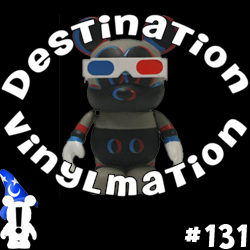
Episode 131 3D Mickey Chaser

Ep. 131 3D Mickey Chaser

This week we review the D23 Expo. The Vinylmation, the events, the stores and the people. Nick chooses his set of year and MC says not so fast. We also have news about a new Nightmare blind box series, more NYC vinyls, Halloween Tokyo figures and much more.

Listen in Popup Player

Download podcast

WDWNT: The Magazine – Bob Gurr: The Wizard of Wheels

Bob Gurr: The Wizard of Wheels

by Daniel Butcher
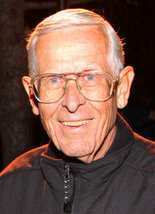
Everyone who has visited a Disney park worldwide has experienced the creativity of Bob Gurr.  When reviewing the numerous vehicles and attractions that he has helped bring to life, his two and a half decades as an Imagineer seems too short for the magnitude of his achievements.  Bob Gurr’s design career did not end after he left Disney, but continued to grow into new and unexpected areas.  With a legendary career and an infectious personality, Bob continues to be a Disney fan favorite.

Detroit Dreams

On October 25, 1931, Robert Henry Gurr was born to Henry and Helen Gurr in Los Angeles, California.  Young Bob was a creative boy who was an energetic handful for the teachers unable to keep him occupied.  In fact, Gurr was expelled from the third grade and sent to the Burbank Military Academy where he enjoyed their project centered curriculum in place of the repetitive grammar school curriculum.  Gurr’s enjoyment of unique and varied projects would stay with him for a lifetime.  When the Army took over the academy during World War II, he returned to public school, but now in Junior High he could select electives, courses he would excel in while he tended to lag in the required courses.  An architecture teacher noticed young Bob’s desire and ability to design automobiles and allowed him to free draw cars when his assignments were completed.  That same teacher later encouraged Gurr to attend the Art Center School in Los Angeles and its newly formed Automobile Design department.

Gurr entered the Art Center School in 1949, the first year it was authorized to offer four year baccalaureate degrees.  In 1954 the school would be renamed the Art Center College of Design.  The instruction focused on something Gurr excelled at, real world skills.  The curriculum prepared students for jobs and immediate employment.  Gurr, like many graduates, found themselves employed quickly.  Before graduating, General Motors, who had provided him a scholarship halfway through his program, hired him as an automobile stylist.  In May 1952, Gurr left California for Detroit, Michigan with his Bachelor of Arts Degree in Industrial Design and hopes for his future in the automobile industry.  Before he even arrived in Detroit, his position was moved to Ford.  Dissatisfied with the politics of major auto companies and designing hub caps, he left a year later and returned to California.

In California he made ends meet by two means.  The first was writing books on car design including How to Draw Cars of Tomorrow, which he published after graduating college, and Automobile Design: The Complete Styling Book.  The second paycheck was contracted automobile design jobs for local and Detroit based firms.  One day the Placement Officer of the Art Center College would ask Gurr a fateful question, “Do you ever do outside work?”  To that point Gurr hadn’t, but today he said yes.  The yes would change his career path and introduce him to a new concept, the theme park.

Disneyland

After Gurr’s return to California he spent much of his free time with a member of his car club the “Road Burners”, Dave Iwerks.  This included frequent dinners at the Iwerks’ home where Dave’s father Ub talked about his day at Walt Disney Productions.  Ub Iwerks was already a Disney legend as the original animator of Mickey Mouse and was at the time engrossed in his work at the Special Process Lab.  At one of these meals the senior Iwerks mentioned a small car driving around the studio that was only had a chassis.  Gurr did not realize that this small comment would be linked to his own future.  The outside work that Gurr was referred to in the summer of 1954 was to design the body of that little car under the supervision of Studio Machine Shop Manager Roger Broggie.  The car was for an attraction for Walt Disney’s new project, Disneyland, to open in 1955.

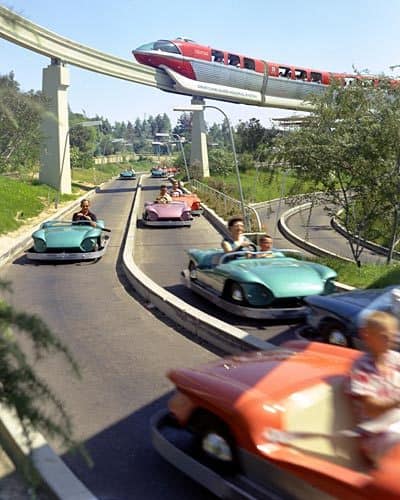
Gurr was brought to the studio to serve primarily as the stylist for this little car.  Walt Disney had decided to design his own car for his driving attraction instead of buying an off the shelf model.  Gurr soon found out that he was also expected to draft the car’s parts so they could be massed produced.  Suddenly the designer found himself working as a mechanical engineer.  Bob spent his evenings drafting for Disney and his days working at an automobile design firm.  Every Saturday he drove down to the studio to show his designs and drawings to Broggie and other Disney employees.  One Saturday in December 1954, Broggie remarked that he wanted to keep Gurr busy with Disney work.  Gurr remarked maybe he should quit his other job.  Broggie jumped at the comment, took Gurr to the Personnel Department, and signed Gurr on as a full-time employee immediately.  Gurr provided his own first official title, Director of Special Vehicle Development when a title was needed for business cards.  Bob was officially a regular employee for WED Enterprises and added to the full-time team targeting Disneyland’s opening.

Gurr designed the body for Disney’s new attraction car.  His alma mater the Art Center College made the clay model of the design, saving Disney money by using student labor.  Additionally, Gurr redesigned the chassis that was to be put under his car design.  Disney contracted Glasspar to craft 40 of the Gurr fiberglass bodies for the car and MAMECO Engineering to assemble the vehicles for the Richfield Autopia, sponsored by Richfield Boran Gasoline.  As each of the 40 cars were completed they were delivered to Disneyland, without bumpers.  Aluminum bumpers were added at the suggestion of Disneyland sponsor Kaiser Aluminum.  The cars had a maximum speed of 25 miles per hour, but pre-set governors limited the speed to 11mph.  The original cars had two accelerators pedals; one was built for the shorter legs of children.  And each car had automatic braking which engaged when the foot was lifted from the gas pedal.  There was also a parental hand brake placed under the dash and a long brake handle mounted to the body for ride operators.  In testing Gurr discovered that unlike steel bumpers the aluminum models failed to spring back into shape and were becoming warped as ride operators tested the cars.  As he prepared for opening day, Gurr’s biggest worry was the damage that guests would do to the bumpers on the 40 Autopia vehicles.  Gurr had also made plans for an Autopia bus to give small children rides, but it was never built.
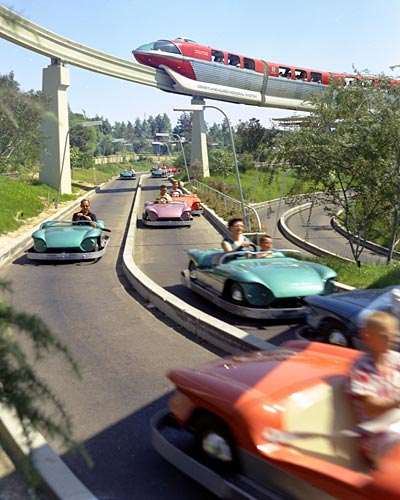
On July 17, 1955, Walt Disney presented his new project to the world on ABC television.  During the Dateline: Disneyland program, Bob lead 20 of the Autopia cars in the Opening Day Parade.  After the parade chaos ruled at the Autopia attraction.  The cars were in disastrous shape.  The bumpers, as Gurr feared, were distorted from guests bumping.  There were a large number of other car problems ranging from brake damage to shot bearings.  Cars could pass each other on the two lane road, and accidents did occur including spin outs on the roadway.  The guests, after waiting in long lines to drive, were treated to cars without padding on the steering wheels, which lead to Gurr taking several children to First Aid with broken teeth.  Additionally the ride operators were beat up between collisions with drivers and bruises from kick starting stalled cars.  By the end of the week only two of the 37 cars used on the attraction were still running (one car of the original 40 was a special model for Walt Disney, and two were styled as police cars for ride operators).  Gurr pulled his own tools out of the trunk of his car and began to reconstruct the broken vehicles.  Soon after Disney provided two mechanics to repair the broken cars while Bob spent the summer redesigning the cars to survive the daily wear and tear of guest usage.  By the end of the summer he had turned most of the original cars into improved Mark II or Mark III models.  Gurr and the Autopia team soon after designed a new drive package for the cars and converted all Autopia vehicles into Mark IVs.  By 1958, park operations decided to redesign the cars yet again creating the Mark V model for use in the Tomorrowland Autopia and in a new Fantasyland version of the ride.  This updated version of the cars would run until 1965.

While designing the Autopia vehicles, Walt Disney asked Gurr to add another project to his workload.  Disney wanted authentic antique vehicles travelling on Main Street U.S.A. to help set the mood for the turn of the century community.  While shopping for authentic cars to use in the park Bob realized that they would never handle the day-to-day wear of life in a theme park.  So instead of refurbishing antiques, he decided to create vehicles that looked authentic but actually used modern, off the shelf parts.  On opening day, three “Gurr-mobiles” were present in the park. Two were travelling from the train depot to the central plaza; one red horseless carriage and a two-story Omnibus ferried guests, while a Carnation truck stayed parked for viewing.  Though built with modern parts, Bob made sure that each authentic reproduction antique both ran and sounded period accurate.  In 1957 a yellow horseless carriage and a second omnibus were added to the fleet.  A year later Gurr remarked to Disney that they did not have a fire engine, which he thought they should have, leading to his commission of creating an antique fire truck.  Bob drove the engine down the Santa Ana Freeway himself to deliver it to the park.  And the fire engine was such a hit with Walt Disney he often drove it around the park before the gates opened.  Gurr’s Main Street vehicles with their one way trips have carried weary guests for generations.  The vehicles typically take 7.5 minutes to make a round trip at four miles an hour.  They accommodate approximately 150 guests an hour.  Gurr did not build any backup vehicles, but luckily in their first 20 years of operation there was only one breakdown.

During the early years of Disneyland Gurr completed a number of projects.  One was a streamlined narrow train that ran from Tomorrowland to Fantasyland.  Gurr added to the Disneyland Railroad by designing the Excursion Train which debuted in 1958.  Then he moved out of simply creating vehicles and started designing other show elements.  For example he developed the mechanics behind the dancing tribesmen of the Jungle Cruise and the dancing tall flowers of Alice in Wonderland.  Despite the magnitude of these projects, arguably Bob’s greatest triumphs were yet to come.

Growing Disneyland

With Disneyland open, Gurr continued to create attractions, especially transportation themed, for the park.  These new projects would include trains, spaceships and a return to Autopia.  Bob would also be asked to contribute to the animation of a beloved President.

Walt Disney and many of those that worked for him, including Gurr’s boss Roger Broggie, loved trains.  Disney decided he wanted a streamlined train for his park and Bob was tasked with designing this train.  Gurr observed the General Motors Aerotrain running between Los Angeles and Las Vegas, and loved the design.  In February 1957, Bob drafted the design drawings of a train based on the Aerotrain and had the drawings completed in 20 days.  He went to a local junkyard and purchased 1954 Oldsmobiles which he used to design the cowl, windshield and front doors, shortening the bodies since the train would be smaller than a car.  A Chevrolet 327 engine and an eight-wheel drive gave the new train greater speed than the typical train, giving it the label of the world’s fastest miniature train.  On June 26, 1957, the Viewliner began operation between Fantasyland and Tommowland.  Despite electrical problems and a coach fire, Walt Disney served as the first fireman of the streamlined train, with Gurr as engineer on the track between Fantasyland and Tomorrowland.  Bob missed the first station on the opening ride.  He backed up to the platform and was then berated by Walt Disney for not blowing the whistle three times to alert bystanders that he was backing up.  The Viewliner would only run until September 15, 1958, when it was removed for the construction of other Gurr projects.

In October 1958, Walt Disney returned from a trip to Europe and requested his designers develop a version of the German Alweg Monorail for Disneyland.  The Viewliner served as a foundation for designing the new train.  Gurr used the same structure for the new attraction, from the floor up and including the doors, windows and face to face seating, all based on his miniature train.  Despite having mechanical precedents to work with in the Alweg Monorail and the Viewliner, Gurr found the new train visually displeasing.  He thought it looked like a bread loaf on a rail.  Bob reached back to images from Buck Rogers and curved the skirt around the skids to hide the shape and give the train a sleek futuristic look.  The original red Monorail train opened on June 14, 1959.  The train was on its beam for only two weeks before opening and experienced electrical issues on opening day.  Gurr expected the train to catch on fire!   For the inaugural ride, Vice President Richard Nixon and family joined Walt Disney with Gurr as Engineer.  After the Monorail had left the station Nixon realized he had left his Secret Service detail at the platform.  At the insistence of the Nixon children the party took a second trip, with Bob worrying about potential fires and the wrath of the Vice President’s bodyguards.  When Nixon left the attraction after the second ride, he was amused to find his detail remained on the Monorail thinking that Nixon was riding again.

Also during 1958, Disney asked Gurr to develop another transportation based vehicle, a bobsled shaped roller coaster car.  When his design was completed, Broggie asked Gurr to begin laying out the track to fit within Matterhorn Mountain.  Bob worked with Ed Morgan and Karl Bacon of Arrow Development who had developed a new bent steel pipe track roller coaster system.  Teaching himself trigonometry, Gurr did the calculations by hand.  Once he had a track layout that fit within the confines of the mountain’s structure, Arrow built the fan favorite Matterhorn Bobsleds which opened along with the Monorail on June 14, 1959. The highly successful ride proved Gurr could design beyond wheeled mass transportation.
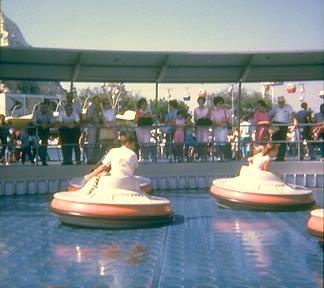
Photo of the Flying Saucers attractionWith trains, cars and sleds under his belt, Gurr moved to flying saucers!  An inventor brought a bumper car style ride vehicle to WED hoping to sell it to Disney.  Bob was one of the first to try out the gas powered hover craft.  It was loud and blew dust everywhere, a safety hazard in Gurr’s opinion.  But the idea did not go away and Morgan and Bacon developed a concept of using a unpowered vehicle on a platform of pressurized air.  Bob designed a flying saucer attraction car for their new concept.  The Flying Saucers opened to guests on August 6, 1961, but technical problems led it to run for one day short of five years.  In 2012 the concept would be revisited with Luigi’s Flying Tires at Disney California Adventure.

Gurr like others at WED saw much of his efforts redirected to new projects when Walt Disney decided to participate in the 1964 New York World’s Fair, somewhat as an experiment to determine if a Disneyland like theme park could find an audience in the Eastern United States.  Bob returned to his Detroit automobile roots with the Ford Magic Skyway, in which he modified Ford, Mercury and Lincoln convertibles into ride vehicles.  But the fair also provided Gurr with something new, people!  The Disney team had added a late project sponsored by the state of Illinois, Great Moments with Mr. Lincoln.  The star of the show was to be full sized animated figure or Audio-Animatronic of Abraham Lincoln.  The mechanics of the figure were currently too heavy and it was too limited in movement.  In less than 90 days, Gurr dissected the Lincoln frame, analyzed the desired motions and rebuilt the mechanics with lightweight materials.

The years after the World’s Fair were focused on transportation for Gurr.  He worked to improve the Disneyland monorail.  The Mark II train included a “double bubble” top based on a request from Walt Disney.  He thought the driver’s view from the monorail was so breathtaking that guests should be able to share it.   The Mark III was lighter and had a lower center of gravity.  Additionally, the Mark III provided an updated and more reliable electric propulsion system.  Introduced in 1968, the Mark III would run at Disneyland and in Las Vegas until 2006.  At the same time Gurr was also assigned a project given the temporary name of PeopleMover, a name that it never seemed to lose.  This slow moving transport provided Bob the challenge of loading guests on a continually moving ride vehicle.  He solved the problem by loading from a moving turntable, rotating slightly slower than the PeopleMover itself.  He also designed the cars used on the PeopleMover, officially known as the WEDway.  The WEDway vehicles included automatic doors and roofs for guest convenience.  The WEDway opening in 1967 would slowly transport guests through Disneyland’s Tomorrowland until 1995, with a Walt Disney World Magic Kingdom version operating to this day.

Gurr’s experience with slow, continuously moving ride vehicles was key in the development of the Omnimover, initially used for Monsanto’s Adventure Thru Inner Space at Disneyland.  The conveyer belt system of ride vehicles allowed Imagineers to turn the guests in any direction.  The Omnimover system has been recycled by Imagineers since its 1967 introduction and includes The Haunted Mansion, Spaceship Earth, and The Little Mermaid: Ariel’s Undersea Adventure.  And finally, Gurr returned yet again to Autopia, with the Mark VII car.  The Mark VI vehicles all suffered cracking due to constant bumping.  So Gurr determined that bumping had to be taken into account to design a longer lasting vehicle.  The chassis of the Mark VII was built to flex to take into account daily torture.  Gurr’s Mark VII’s would run until 2000, when new cars replaced them.  The new and improved vehicles would have better engines and electrical systems, on top of a Mark VII chassis!

Walt Disney World Resort

With the building of a new East Coast resort, the legendary Imagineer was called upon to use his special design and production skill sets.  One of his first tasks was to build the Monorail Mark IV for the Florida resort.  The new model would be required to carry more guests over a greater distance than its California cousin.  Additionally, Gurr had to plan for more extreme weather in Florida, requiring encased components and electrical equipment that could tolerate daily rain.  The Mark IV would run in Florida from the opening of the resort until 1989 when two of the trains became the Las Vegas Monorail, operating until 2004.  Additionally, Bob oversaw the assembly of the 20,000 Leagues Under the Sea submarines at the Tampa Shipyard.  Gurr taught himself electrical design as the drawings of the electrical systems he received from California were inaccurate.  And finally, unable to find a third party product suitable for Disney’s needs, Gurr designed the Walt Disney World Tram tractor to transport guests from the parking lots to the ticket center.  An updated version of that tractor is used at Disneyland to this day.

From 1979 until 1981, Gurr was assigned to assist in the development of Tokyo Disneyland.  Bob traveled to Japan and inspected manufacturing and production facilities.  At the office in Glendale he gathered designs from the team working in Japan and forwarded them oversees.  He enjoyed his time aiding young designers in Japan but found he had lost his enthusiasm for Disney corporate life.  After returning from Japan, he spoke up in a staff meeting about his displeasure.  A month later he was asked to leave, and he resigned of his own will.  When asked in a November 1997 interview with the E Ticket, he noted that he had risen to Senior Staff Engineer.  That role had him reviewing the work of others, including those leading the design efforts in Japan, but did not provide him the opportunity to design himself.  He missed that and wished to return to the drafting table.  Regardless of Bob’s reasons, over 25 years of Disney employment had come to an end.

After Disney

In 1981 the time had come for Gurr to leave Disney. He became his own boss as the head of GurrDesign.  Bob did not go quietly into the night, but instead continued to find new and exciting projects, 117 to be exact until 2000.  Some of these projects were for Disney competitors, including Universal.  He designed a mechanical serpent for the Universal Swords and Sorcery Show and a 30 foot animated figure of King Kong for Universal Studios Tour in Hollywood.  Gurr also took a number of entertainment projects including the 1984 Michael Jackson Victory Tour lighting systems, a spaceship for the closing ceremonies of the 1984 Summer Olympics, and the Las Vegas Treasure Island Pirate Battle Show.  For a man who spent the first half of his career juggling many widely varied projects, these new challenges were business as usual.
Legendary Status

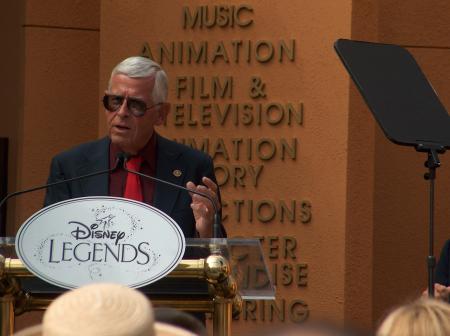
Today guests in Disney Parks around the globe enjoy the legacy of Bob Gurr.  Be it a ride on the Disneyland fire truck, a tour on the Monorail, the bumpy circuit of Autopia, a visit to a haunted graveyard, flying tires and so much more, Gurr’s original, updated and adapted designs are unavoidable.  However, there are still intentional tributes to this legend in Disneyland and Walt Disney World.  In the Disneyland Park above Disney Clothiers one can find a window for the “Meteor Cycle Co” lead by the “Fast, Faultless, Fadless” Bob Gurr.  The window claims that “Our vehicles pass the test of time.”  The longevity of Gurr’s vehicles continues to be proven daily.  The window’s cycle shop theme is based on Gurr’s love of mountain biking, and includes a bike hanging from the building.  In Walt Disney World’s Magic Kingdom Park, Gurr also shares a window with Dave Gengenbach, George McGinnis and Bill Watkins.  They share in “The Big Wheel Co.” makers of “One-of-A-Kind Unicycles- Horseless Carriages.”    Additionally, Gurr has continually shared his stories on blogs and podcasts, highlighting his fun-loving personality and furthering his legendary status with fans.  In 2012 he published those stories in his autobiography, Design: Just for Fun.
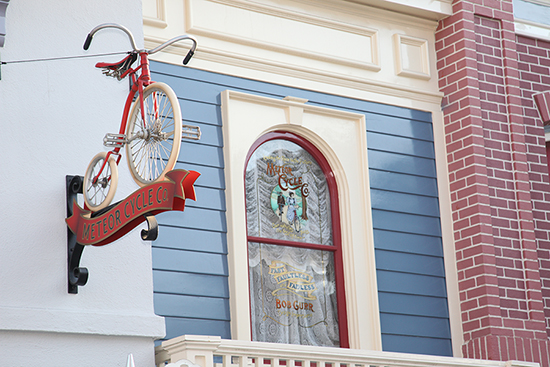
Windows on Main Street, U.S.A., at Disneyland Park: Bob Gurr

It is nearly impossible to capture the fullness of Bob Gurr’s career.  He has provided over 100 designs for Disney Parks, building his legendary status even before Disneyland opened.  Over the years Bob proved that there was no challenge he would not take up, even helping to build a human figure, despite being a trained as an automobile designer.  With his fingerprints deeply embedded into every Disney theme park globally, it is impossible to imagine a Disney vacation without Bob Gurr’s creations.

edited by Michele Gaudet

WDWNT: The Magazine – Mr. Baxter’s Wild Ride

Mr. Baxter’s Wild Ride

by Josh Hall


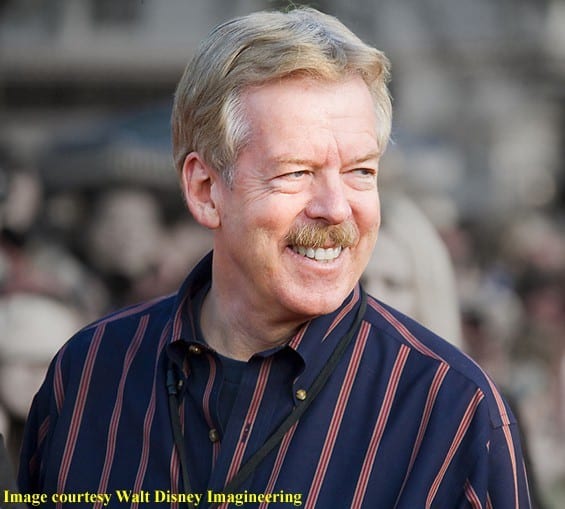
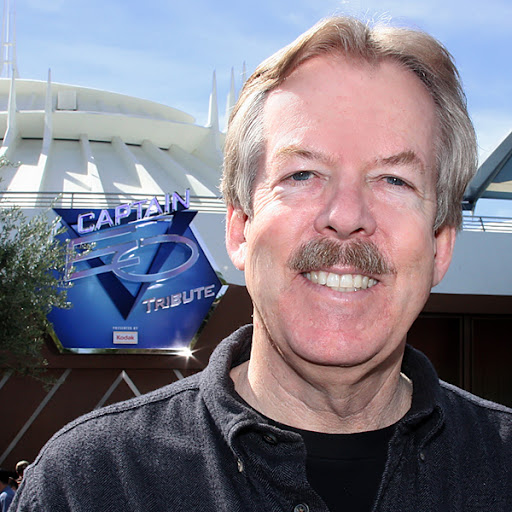
[dropcap style=”font-size: 60px; color: #9b9b9b;”] T [/dropcap]ony Baxter. It’s not necessarily a household name and for most, it’s not even a familiar one. True enough, if I asked you to name an influential person in the history of Disney Theme Parks, Tony Baxter might not even come to mind. But for some of you, this behind-the-scenes giant of Imagineering is the first person who comes to mind.

It’s been a few weeks since Tony announced that he was stepping down from his position as Senior Vice President for Creative Development at Walt Disney Imagineering and reactions have run the gamut from anger to sadness. Tony Baxter has left his mark on the hearts of millions through his designs, his ideas and his imagination.

But who is Tony Baxter and what has he done in the past 47 years?

Travel back in time with me to 1965. There’s a young teenager working at Disneyland; sweeping footpaths, scooping ice cream, and operating a ride or two. He’s working hard to help pay for his college degree in Theatre Design from California State University in Long Beach, California. Starting with that simple cast member position, he would have the same employer for the rest of his life. Having graduated in 1969, he presented Walt Disney Imagineering (originally known as WED Enterprises) with a portfolio including a model of a “Marble Maze”. WDI, impressed by the maze’s precision, gave this young man a job. That young man’s name was Tony Baxter.

Tony’s first assignment as an Imagineer was to work on Walt Disney’s newest project which was not in Anaheim but in Florida, where “the blessing of size” provided plenty of room for the creations of WDI. The Walt Disney World resort opened in 1971 and, with such a large canvas, it’s no wonder that Tony’s talent and vision shined so brightly.

His first big step came in the mid-70s back at Disneyland in California when he designed a concept model for a new attraction with sort of western theme – a runaway mine train. In 1979, Tony’s model of that attraction became a reality when Big Thunder Mountain Railroad first delighted Disneyland guests. Today guests in California, Florida, Tokyo, and Paris continue to experience and enjoy the thrills of an attraction that started as Tony’s model.

The 1980’s parlayed Tony’s success into a more active role within Disney. 1983 saw a complete overhaul and redesign of Disneyland’s Fantasyland. The overall renaissance theme and architecture was changed and replaced with colors and textures of a Bavarian village, thus invoking thoughts and feelings of a true fairytale among guests.

All of this took place under the direction, oversight, and supervision of Tony Baxter.

With such a positive reception, this design standard was repeated and copied at Disney theme parks around the world, proving that Cogsworth knew what he was talking about when he said, “If it’s not baroque (broke), don’t fix it.” That same year, Tony led the creative efforts that brought us the Journey Into Imagination pavilion (now Imagination!) at Epcot.

Brer Rabbit's quest for adventure and his rival's plot to do him inlaunch Walt Disney World guests on an action-filled journey with athrill-packed, five-story "splashdown" finale on Splash Mountain inthe Magic Kingdom.

One day while driving to work, Tony began to brainstorm on an attraction that would bring more guests to Disneyland’s less popular Bear Country (now Critter Country). The light bulb above his head flickered on and the idea for Splash Mountain began to take shape. In 1989 one of the most expansive projects in Disney Theme Park history opened and the first guests took the plunge into the Briar Patch. Two more versions of Splash Mountain now exist at Walt Disney World and at Disneyland Tokyo and all three continue to draw long lines of excited guests.

Even in light of all of this success, 1989 was a trademark year for Tony Baxter. Not just because of Splash Mountain, but because he was named Senior Vice President of Concept, Development, and Design in time for the design of Disneyland Paris which opened as Euro Disneyland in 1992.

The 1990s brought continued success for Baxter. Following in the successful footsteps of the Indiana Jones Epic Stunt Spectacular, another Indiana Jones based attraction was developed and created at Disneyland. The Indiana Jones Adventure: Temple of the Forbidden Eye was designed and constructed by a well-oiled machine of some 400 Imagineers led by Tony Baxter.
In 1998, Tony led a creative team to redesign Disneyland’s Tomorrowland area. The latter parts of Tony’s amazing career have seen the opening of the Finding Nemo Submarine Voyage, the reopening of Captain EO, and the redesign of Star Tours.

On February 1st of this year, Tony informed his fellow Imagineers via an open letter that he would be stepping down from his current role and into an advisory position. He’ll still be an influence – just not a full-time one.

In his 47 year career, Tony Baxter created numerous enduring Disney classic attractions, redesigned others, brought smiles to the faces of people on other continents, and creatively designed an entire Disney theme park, all of which beg to answer just one question: What have you done lately?


[quote]“It has been a wondrous 47 years spanning the opening of Walt Disney World to Big Thunder Mountain Railroad and Star Tours, from Epcot’s original Journey into Imagination to Disneyland Paris and Indiana Jones Adventure. The Imagineers I have known and shared these times with have provided invaluable experiences not to be found anywhere else on earth. The future of Imagineering and Disney Parks is incredibly bright.” – Tony Baxter[/quote]

WDWNT: The Magazine – “Marc Davis: Imagineering Master”

Marc Davis: Imagineering Master

By
Daniel Butcher


Everyday guests of the Walt Disney World Resort enjoy the efforts of largely unknown and unnamed Imagineers.  Imagineer Marc Davis began to impact theme parks years before Walt Disney dreamed of Disneyland.  Davis was a late comer to attraction design, working in animation when Disneyland opened.  From animation to attraction design, Davis has left a mark on the Disney experience and his legacy continues today where it started, in film.

Marc Fraser Davis was born March 30, 1913, in Bakersfield California.  But California is not where the Davis family stayed.  Davis’ father, Harry A. Davis, was a wandering jeweler and magician who attempted to strike it rich in the boomtowns of the United States with his wife Mildred and son in tow.  The nomadic life of the Davis family meant that young Marc was always the new kid in town, attending 23 different schools before he graduated.  From Florida to Oregon the Davis family was vagabonds.  Alone and generally friendless, Davis turned to drawing to fill his spare time.  He became a self-taught artist sketching at local zoos and copying illustrations from anatomy books he found in libraries.  After high school, Davis sought formal instruction at the Kansas City Institute of Arts and European art schools.  Realizing he desired to be a professional artist, Davis attempted to get hired by the Walt Disney Studio and submitted an application under the name M. Fraser Davis.  The studio rejected the inquiry, noting they were “not hiring women artists.”  Davis used his full first name in future inquiries to overcome the prejudices of the day and on December 2, 1935, started as a Disney artist.


marc-davis

Animator

            Davis’ first major assignment at Disney was to serve as an assistant animator to Grim Natwick on Snow White and the Seven Dwarfs.  Natwick had helped develop Betty Boop.  Natwick further Davis’ skills as an artist.  Being noticed for his talent, Davis was moved into the Character Model Department after concluding his work on Disney’s first feature film.  In his new role, Davis’ understanding of animal form shined with him developing the models for characters such as young Bambi and Thumper.  Walt Disney was especially impressed with the David designed skunk, Flower.  Bambi encompassed six years of Davis’ career as he was moved into an animator position.  Davis finished the 1940s at the studio animating more animals including Brer Rabbit and Brer Fox in Song of the South for which he was the directing animator.  He also began a 17 year teaching position at Chouinard Art Institute, where he met a young female student named Alice Estes who would later become his wife years later.

With 1950’s Cinderella, Davis began over a decade of designing and animating female characters as he continued in feature films.  He was the directing animator for the title character Cinderella.  Additionally he animated one of Walt Disney’s favorite animation sequences ever, Cinderella descending the staircase in the mouse-made dress.  He also animated the Cinderella transformation scene as the fairy godmother dressed Cinderella for the ball.  Cinderella was followed by Davis overseeing the animation of Alice for 1951’s Alice in Wonderland.  For 1952’s Peter Pan Davis was charged with creating and animating Tinker Bell.  In Peter Pan, Davis had to draw a fairy that both communicated and emoted purely through motion being a character without a voice.  For Sleeping Beauty in 1959, Davis oversaw the development and animation of both Maleficent and Princess Aurora.  And finally Davis contributed the character of Cruella De Vil to 1961’s 101 Dalmatians, a character that he alone animated for the film.  Davis’ animation creations alone are sufficient to label him a Disney legend.

Davis’ female characters were known for having strong personalities.  A onetime avowed bachelor, Davis was known in the Disney studios for courting strong-willed women, and it was natural that the personality traits that he found attractive would emerge in his creations.  He designed characters with large hands so they could be more expressive when animated.  Many observed that Davis was able to create characters that audiences were attracted to.  However, Davis himself did not enjoy these years of designing female characters.  He found rotoscoping, tracing over live action film, uninteresting and desired to animate animals, not heroines and villainesses.

The legacy of Davis’ animation years can be seen throughout Walt Disney World, especially the Magic Kingdom.  Be it character development or animation, Davis helped construct the images and personalities of the characters guests love today.  At the heart of the Magic Kingdom Park guests find Cinderella’s Castle where one can meet Davis’ creation in flesh and blood at Cinderella’s Royal Table, and Aurora and Snow White may also be found in the dining room as well as through the park.  Tinker Bell also can be found throughout the Magic Kingdom from the magic of waking her up at Tinker Bell’s Treasures, flying high in Peter Pan’s Flight or seeing her star in the nightly fireworks streaking across the sky in Wishes.  Tinker Bell has been featured in the Magic Kingdom nightly fireworks since she took flight for the first time on July 4, 1985.   Fantasmic! at Disney’s Hollywood Studios features Maleficent as the villain ringleader invading Mickey’s dreams including co-conspirator Cruella De Vil.  And Snow White and Tinker Bell both make appearances in this nighttime spectacle.  From Snow White to Cruella De Vil, everyday Walt Disney World guests enjoy the fruit of Davis’ animation career.

legends-web

Imagineer

Davis had remained with animation for the early years of Disneyland’s existence.  In 1962, Walt Disney invited Davis to visit Disneyland and provide notes on the troubled Mine Train through Nature’s Wonderland attraction.  Davis suggested that the mine cars be reorientated to allow guests to better observe the story and provided suggestions on gags to make the ride more playful.  Pleased with his feedback, Disney asked Davis to provide direction on reimagining The Jungle Cruise.  Davis’ suggestions included the Indian elephant pool and the trapped African Safari, gags which were included in the Walt Disney World version of the attraction. Additionally, Davis supported the development of the Enchanted Tiki Room, in which Davis designed the talking Tiki poles and artwork adorning the attraction walls.   The Walt Disney World version of the attraction was available to guests on opening day titled Tropic Serenade and was re-imagined as The Enchanted Tiki Room (Under New Management) including Davis’ Tiki poles and art.  In summer 2011, Imagineers returned the attraction to its classic beginnings as the Enchanted Tiki Room.  With these attractions under his belt, the veteran animator would not return to feature animation, he would now animate in three dimensions.

Davis was assigned to all of Disney’s projects for the 1964-1965 World’s Fair, including those that would influence Walt Disney World attractions.  He was asked to animate the Audio-Animatronic’s movements including standing for Great Moments with Mr. Lincoln a precursor to the Hall of Presidents.  He added story elements to The Carousel of Progress which was moved from the fair to Disneyland.  On January 15, 1975, it reopened in its new home in the Florida Tomorrowland and is currently Walt Disney’s Carousel of Progress.  Finally for it’s a small world, Davis provided story ideas, including gags that adorned Imagineer Mary Blair’s backgrounds.  For this attraction he worked with his wife Alice who created costumes for the Audio-Animatronics.

Among the original projects Disney gave Davis was a pirate wax museum that had been in development since 1958.  Davis made some initial sketches, but put his work aside for the World’s Fair projects.  Past dark rides, enclosed in a show building, retold established Disney stories such as Peter Pan.  The pirate ride would lack a story that provided guests a pre-established context.  Instead of a story, Davis immersed guests into an experience.  He was teamed with former background painter Claude Coates who created the ride’s sets for Davis’ characters and humorous gags.  Davis and Coats lead the team which brought the Pirates of the Caribbeanride to completion on March 18, 1967, at Disneyland.   “Pirates of the Caribbean” was absent at the opening of Walt Disney World.  Davis had plans for an even more elaborate boat dark ride named Western River Expedition which would have taken guests through old west scenes.  But due to guest complaints about its absence, executives called for a version of the Disneyland ride.  Davis’ river ride was shelved for a new version of Pirates of the Caribbean.  Dissatisfied Davis did use the new ride as an opportunity to update the story, ending the ride in a treasure room instead of the arsenal.  The pirates of Florida would get their ill-gotten loot opening on December 15, 1973.  Meanwhile Audio-Animatronics planned for the Western River Expedition such as buffalos and chickens would make their way to Living with the Land at Epcot.  And concepts from Davis’ plans would help inspire Big Thunder Mountain Railroad and Splash Mountain.

A haunted house attraction had been planned for Disneyland as early in 1951 before the park opened.  The exterior had been completed during 1963 in New Orleans Square, but the attraction did not yet materialize despite promises of coming soon due to other commitments such as the World’s Fair.  A number of Imagineers including Ken Anderson, Rolly Crump, and Yale Gracey had worked on the attraction but progress was slow.  In 1964, Davis completed his first recommendations for the attraction, which included the introduction of the narrating Ghost Host.  But it was not until 1966 after the death of Walt Disney that Dick Irvine reunited Davis with Claude Coats to oversee the completion of the haunted house attraction.  The relationship was tense, with the designers divided between a Davis preferred funny attraction or a Coates preferred scary attraction.  Both got some of what they desired, delivering an attraction that included both scary and comedic moments.  Davis’s fingerprints are all over the design of the current Haunted Mansion.  He painted the stretching room paintings introducing visitors to the special humor of the ride and provided the climax in the graveyard filled with visual gags.  On August 9, 1969, the long awaited Disneyland “Haunted Mansion” opened to record crowds of 82,516.  While the Disneyland version was being produced, a second version with a Colonial façade was being built in Florida.  In April 1971 the attraction was complete and The Haunted Mansion was among the opening day attractions of Walt Disney World on October 1, 1971.

In November 1966, Walt Disney had visited Davis and discussed his future project, The Country Bear Jamboree for Disney’s Mineral King Ski Resort.  Disney told Davis his musical bears were a winner.  As he left, Disney did something he never did.  He said, “Good-by Marc.”  Three weeks later Disney died.  This had been Davis’ last meeting with Walt Disney.  Plans for the Mineral King resort fell through, but the musical bears made an appearance at Disneyland and still perform daily in Florida’s Frontierland.  Davis continued working as an Imagineer, developing his favorite attraction, America Sings, a musical Audio-Animatronics show featuring 114 characters which replaced Carousel of Progress at Disneyland.


The Artist’s Mark

In 1978, Davis retired after 43 years with Disney.  Even in retirement he still contributed creatively to Imagineering.  He consulted on Epcot’s World of Motion attraction and Tokyo Disneyland.  Davis’ humor was evident throughout this extinct attraction.  Included among the scenes was a train robbery originally intended for the Western River Expedition.  He continued to draw on a daily basis, spoke at Disney fan events, and enjoyed his retirement.  On January 12, 2000, Davis suffered a stroke.  Later in the day with Alice at his side, he passed away.

There are a number of tributes to Marc Davis throughout the Walt Disney World Resort.  The most obvious tribute is the window on the west side of Main Street U.S.A that bears his name.   The window lists, “Big Top Theatrical Productions” which has been “Famous Since 55.”  Also listed on the window are three other Imagineers including Davis’ Pirates and Haunted Mansion partner Claude Coats.  Another tribute can be found in Disney’s Hollywood Studio in the Magic of Disney Animation courtyard.  There four of Walt’s Nine Old Men including Davis set their handprints in concrete slabs.  Additionally there are hidden tributes to Davis throughout the Magic Kingdom Park.  In the final scene of Pirates of the Caribbean a family crest with the name “Marco Daviso” can be found hanging from the wall as Jack Sparrow delights in his treasure.  In the Haunted Mansion queue a tombstone tribute can be found.  The stone reads, “In Memory of Our Patriarch Dear Departed Grandpa Marc.  Finally, near Country Bear Jamboree a crate is labeled Davis Tobacco.  The subtle and not so subtle nods pay tribute to a true Imagineering legend.

Walt Disney Studios has honored Davis for the entirety of his Disney career.  In Disneyland he is honored with another Main Street window, “Far East Imports – Exotic Art” with Davis as proprietor.  The window celebrates his love of Papua New Guinea.  The neighboring window was revealed May 10, 2012.  The window announces Small World Costuming Co., with Seamstress to the Stars Alice Davis.  In 1989, Davis was named a Disney Legend.  Additionally the company awarded him the Mousecar, a highly exclusive honor, for service to company.


Back to the Movies

Davis’ career began in movies with Snow White so it is only fitting that his work as Imagineer has influenced recent movies.  In 2002, The Country Bears was released and though a box office disappointment started a line of Davis’ influenced movies.  In 2003, The Pirates of the Caribbean: The Curse of the Black Pearl became a blockbuster and featured gags designed by Davis that were adapted from the ride.  The original film was followed by three financially successful sequels.  Pirates of the Caribbean: The Curse of the Black Pearl was followed months later by the financially successful The Haunted Mansion starring Eddie Murphy which included Davis gags familiar to park goers including several from the graveyard.  Future Disney film projects continue to be influenced by Davis story work with a planned Jungle Cruise movie, sure to have an elephant bathing pool, and a second darker Haunted Mansion film to be directed by Guillermo del Toro.  It was just not his story work that has influenced movies but also his life story!  The story team for Disney Pixar’s 2009 Up interviewed former Imagineers to determine “What are the most important things in life?”  Alice Davis was interviewed and the Davis marriage including their shared love of adventure helped influence the development of the characters Carl and Ellie Frederickson.   

Marc Davis has left a long-lasting legacy on the Walt Disney World Resort.  The characters he both animated and designed are honored in the rides guests visit today.  Additionally, he helped design many of the attractions that today we label as classic.  Davis was a renowned story man, using character to move story forward in film and attractions, so it should be no surprise that his work continues to inspire Imagineers, movie makers and guests today.

Daniel Butcher is a husband and father who looks forward to spending time with
his family in Disney Parks. Daniel can be reached at
dbutcher23@betweendisney.com.

The Great Destini Amazes at the 2011 D23 Expo

While living characters in the Disney Parks is not necessarily a new thing, The Great Destini is an amazing, autonomous audioo-animatronic living character that was first tested at Innoventions at Disneyland a few months ago. Destini was brought out again for the D23 Expo last weekend and we got a pretty good look at him. It is time to be amazed by a marvel of Walt Disney Imagineering, The Great Destini!