Disney Files Patent for Theme Park Rides Controlled by Guest Emotions

Disney has filed a patent for a ride system that can alter the guest’s experience based on their emotions.

“Sensing and Managing Vehicle Behavior Based on Occupant Awareness” looks at a way to read riders’ emotions or pre-determined interests to create personalized ride experiences. For example, the patent states that via a camera on the vehicle or a wearable ID device — say a MagicBand — a ride system could read rider facial expressions such as being excited or bored, and then alter the course of the attraction to increase/decrease speed, spin more or less often, change the tone of display scenery and/or more to improve the ride for guests.
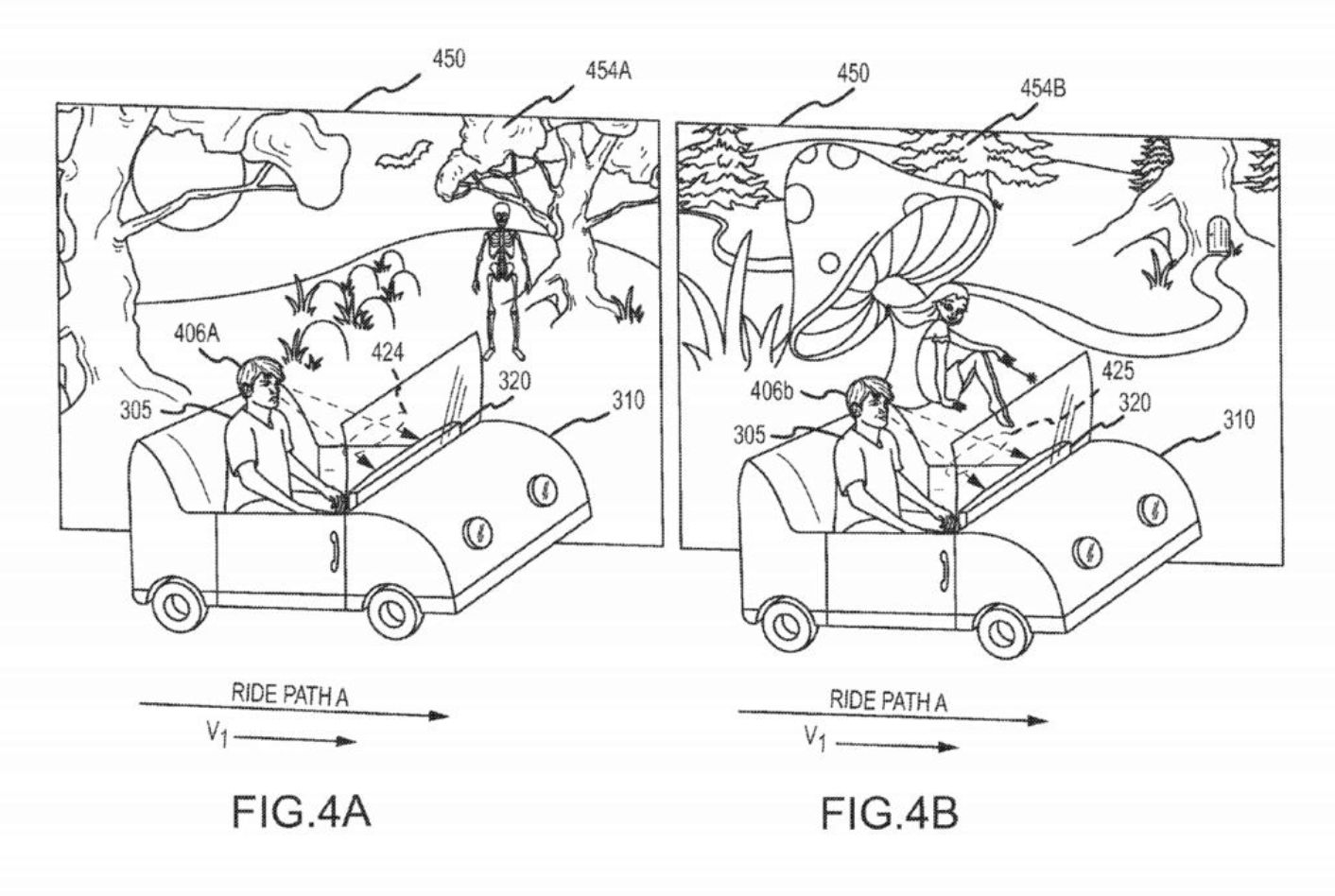
Patent for ride controlled by a guest's emotions.

Patent for ride controlled by a guest’s emotions.

“The technology would allow rides to adjust show content appropriate for pre-teens, teenagers or adults; or for thrill-seeking and non thrill-seeking passengers. The control system may also operate the vehicle to address (e.g. even solve in some cases) motion sickness issues for passengers such as by adjusting speed or movement patterns of a vehicle. [Through RFID or some other identifying system] access one or more ride experience goals (or expectations) for the occupant. For example, the occupant may simply desire transportation while in the automated trackless vehicle and, hence, will not be wanting to interact with to be entertained by external display systems. In other cases, though, the occupant may have provided goals/expectations (e.g. by completing a questionnaire on a website or the like) that indicate they want to be educated during the ride, be entertained in a particular manner during the ride, be informed of sales on services or merchandise during the ride, and so on. In the same or other cases, the goals/expectations may indicate whether the ride experience should be thrilling, as smooth as possible, or something in between.” 

The technology could add speed changes, spins and sharp corners for riders who seem bored or have provided prior information that they enjoy thrill rides. In addition, the patent states it may be able to sense passenger comfort levels such as temperature and alter the air-conditioning of the ride to make it more pleasant.

The ability for passengers to customize the ride experience also was mentioned in the patent.

“The ride/travel path may be selected to meet the occupant’s goals, such as to take the path that can be completed at this time of day in the shortest period of time, to take a path that has the best scenery, to take a path that moves past a particular set of display elements, and the like.”

That time flexibility factor suggests the technology may work with guest’s schedules such as trying to get the most of their theme park visits if they have reservations for another attraction or experience elsewhere.

It is unclear how a ride of this type would be constructed, but it is just a patent for now.

SOURCE: Orlando Business Journal

Disney Creating Animatronic Figures That Can Follow You

The Walt Disney Company was recently awarded US Patent Number 9,424,467, entitled “GAZE TRACKING AND RECOGNITION WITH IMAGE LOCATION,” for a system that can track where guests are looking.

Several excerpts from the patent explain how this system will work:

Various entertainment environments, e.g., theme parks, attempt to track where various participants are looking within such environments. By tracking the gaze of a participant, a computing system may direct various animatronics, automated objects, or the like to interact with the participant. For example, a computing system within a theme park may direct an animatronic character from a movie to make a noise if a participant is looking at the animatronic character.

The gaze tracking configuration calculates the ratio of the amount of white in the eyes of a participant on either side of the iris for each eye of the participant. Further, the gaze tracking configuration estimates where the participant directs his or her gaze by averaging the ratios for both eyes of the participant.

Further, the gaze tracking configurations provided herein are not limited to detecting the gaze of a single person, but rather may be utilized to estimate the gaze of a group of people. During event recording, knowing where a live audience is gazing on a sports field or stage allows for automatic control of a camera to point the camera to the place of interest of the audience. For example, the gaze tracking configuration is configured to detect if a large quantity of audience members are gazing in the same direction. The gaze tracking configuration then provides that gaze data to a camera that is configured to automatically adjust to its orientation in the direction of the gaze. Similarly, understanding how a live audience pays attention to a film presentation or theatrical stage presentation can provide a director with valuable information about how the audience is receiving a film or play.

The generic responses and/or specific responses are also utilized with interactive displays. The specific responses are not limited to videos, pictures, or the like in their entireties. The specific responses are also implemented with respect to the gaze of the participant directed toward a particular scene character, object, or the like within a video, picture, or the like.

It is unknown at this point how Disney may utilize this technology, but one could imagine any of a number of scenarios where a guest could interact with a robotic character as if it were a responsive human controlling the character.  Another possibility is a virtual-reality system where the guest is in control of the experience and the system can determine where the guest wishes to go simply by where he or she is looking.  This is likely to be a part of some of the new, more immersive experiences Disney is planning or building, including Pandora: The World of Avatar, and Star Wars Land.