REVIEWS: “Between-Disney-Vacation” Recommended Reading 101

It’s February. Even though we’re within a few weeks of Daylight Savings — the unofficial gateway to spring — most of the nation still finds itself in the throes of winter for at least a few more weeks. Of course this also means, for most of us, that although we’re getting closer to our next Disney vacation every day there’s still some winter to endure. If you’re like me, life tends to be what happens between visits to the Disney parks. As a way to cope with such a reality I’ve managed to find a few practices — we’ll call this “prep” — that help me deal with the time between trips. Music, podcasts, and of course books are all tools in my Between-Disney-Trips survival kit. So it’s in this spirit that I submit my favorite or most recent “February Survival Reads:”
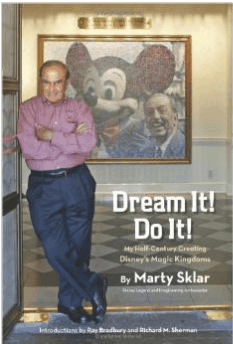
Dream ItDream It! Do It! My Half-Century Creating Disney’s Magic Kingdoms, Marty Sklar
Different from other books I’ve read on the subject of Disney backstory and mythology, Dream It! Do It! by Marty Sklar will be most enjoyed by those most familiar and intrigued by the stories perpetuated by and grounded in Disney lore. Sklar is a career Imagineer that has contributed to every major event in the development of each of the Disney parks. Additionally, he may be the only single person with both a working and personal relationship with anybody that’s anybody associated with the Disney parks story — including the man himself, Walt Disney. This includes the Sherman brothers, John Hench, Mary Blair, Card Walker, Dick Nunis, Joe Fowler, Joe Potter, Claude Coats, and Roy O. Disney. And that is by no means a complete list. If you’re looking for an insider’s perspective and little-known albeit interesting pieces of information associated with Walt Disney World, Disneyland, and even Disneyland Paris and Tokyo, this is your book. What I enjoyed most were the stories about the creation of the engineering and imaginative feat that became Walt Disney World. What I enjoyed least were the inner workings of the corporation itself.
Screen Shot 2015-02-22 at 2.19.46 PMWalt Disney: The Triumph of the American Imagination, Neal Gabler
It’s worth reading just for the behind-the-scenes story on the production of Snow White alone. But the author also takes a deep dive into the early studio years that makes the Walt Disney story that much more accessible to fans and park visitors. There’s some decent stuff on Sleeping Beauty but I found myself wanting more about the genesis and production of Cinderella. For me, this biography has probably been the most comprehensive—even through those painful war years and nature documentaries. Gabler cites pop culture writers of the day and movie reviewers where it is appropriate. Readers Beware: this is quite the commitment. But for hardcore fans, I think it’s also a rite of passage of sorts.
 

Screen Shot 2015-02-22 at 2.22.22 PMThe Haunted Mansion: From the Magic Kingdom to the Movies, Jason Surrell
Even though The Haunted Mansion is one of my favorite attractions, I never could put my finger on why so many Disney enthusiasts were so obsessed with it. My hope was that reading Surrell’s book would help me understand the Haunted Mansion phenomenon and it absolutely has. He begins with the genesis of the idea in the Museum of the Weird for which Yale Gracey and Rolly Crump were commissioned to begin exploring and experimenting with gags for the mansion. Surrell then walks his readers through the whole creative process. Along the way you meet X. Atencio, Marc Davis, Claude Coats, and plenty of others that had a hand in bringing the attraction to life, er, afterlife. The last third of the book addresses each “scene” in the Mansion in detail—but not so much detail as to be overwhelming. It’s an easy read and highly recommended for Disney fans at practically any interest level.
Screen Shot 2015-02-22 at 2.24.33 PMThe Animated Man: A Life of Walt Disney, Michael Barrier
Oddly enough, this has been my favorite Walt Disney biography. Given Barrier’s obvious bent toward the history of animation and Disney’s place in it, I didn’t have the highest expectations. I am generally more interested in Walt’s life than in the medium itself. But the fact is that Michael Barrier made me care. He made Walt’s life through the lens of historical animation even more interesting. I’m not sure I would make this my first biographical endeavor into the life of one of the most influential people of the Twentieth Century. But I would recommend it as the second.
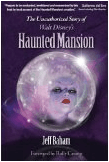
 

Screen Shot 2015-02-22 at 2.26.15 PMThe Unauthorized Story of Walt Disney’s Haunted Mansion, Jeff Baham
This book is everything you would expect from the founder of Doombuggies.com. Jeff is exhaustive in his research and relentless in his pursuit of the most accurate and most thorough Haunted Mansion apologetic. Different from Surrell who takes an Imagineer’s perspective, Baham writes for the person who just can’t get enough of the Haunted Mansion. A couple of reviewers didn’t like the second section of The Unauthorized Story of Walt Disney’s Haunted Mansion and the way it takes readers step-by-step through the Mansion, but that was probably my favorite part. But that is not to say that I didn’t also love all the history and background present in the first half as Coats, Crump, Davis, and Gracey dominate the narrative as they rightfully should. The bottom-line: this is just a really cool book.
 

Screen Shot 2015-02-22 at 2.29.40 PMWalt Disney: An American Original, Bob Thomas
Promoted as the only “authorized” biography by the Disney family, what Thomas does get right is that he doesn’t waste a lot of time on the parts of Walt’s story that might have the potential to drag. Instead, the author gives most of the big story lines equal billing: Oswald, “Steamboat Willie”, Snow White and the Seven Dwarfs, Cinderella, Disneyland, and the World’s Fair. Of the biographies that I’ve read this is perhaps the easier read. I liked most about this book the attention Thomas gives to Mary Poppins, something Gabler’s book misses in my opinion. That being said, a reading of Gabler, Thomas, and Barrier provide what appears to be an accurate view of the man you’ll come to know simply as “Walt.”


Not reviewed here are the two Walt Disney Imagineering books. These are great but aren’t your typical front-to-back reads and tend to focus exclusively on the creative aspect, which isn’t for everybody. Regardless, they are great to have. Four Decades of Magic is a series of essays, some more interesting than others, that includes some very interesting and fun background and content. (For instance, did you know that there is purportedly a ghost that haunts Pirates of the Caribbean Florida? Chad Denver Emerson’s book will tell you all about it.) I didn’t review it here because it doesn’t have the most “finished” feel to it. And I’ve intentionally avoided Project Future but only because I’m just not as interested in the corporate side of the Disney experience. There are plenty of others but I feel good about recommending all six of these books as a part of your 2015 February Survival.
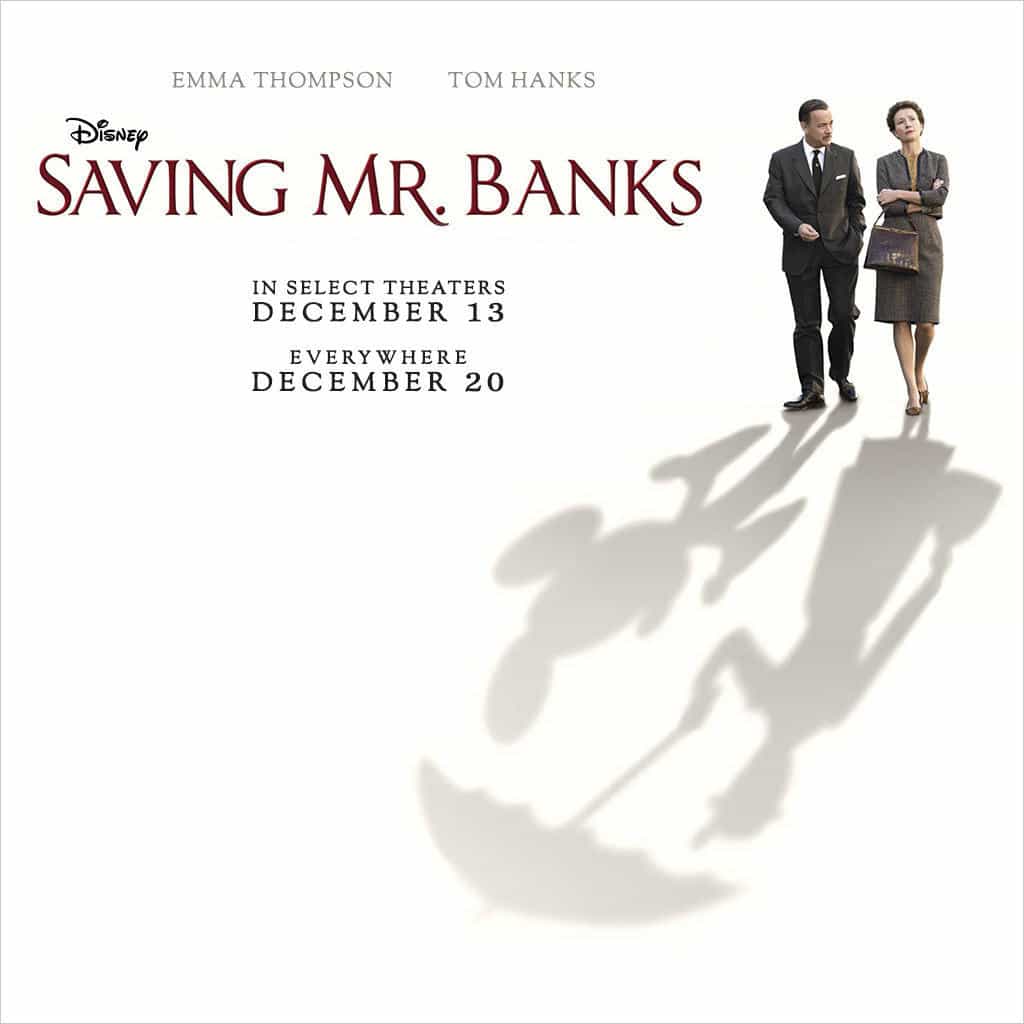
“Saving Mr. Banks” – A Quick Review

SMB_01

Sorry to disappoint the many Walt fanboys waiting with bated breath, but Saving Mr. Banks is hardly the Walt Disney-focused or Disneyland-heavy movie that so many people were hoping for. Instead, it is a well told, brilliantly acted character piece that just happens to feature Tom Hanks in the role of Walt as a supporting character. Liberties are taken with the story and Disney history. While this review will try to avoid specifics, historical dramas have built in spoilers. The boat sank, the Nazis lost, and Mary Poppins got produced.

The movie alternates between P.L. Travers’ youth in turn-of-the-century Australia and 1960s London and Los Angeles. The flashback format works well in keeping suspense for a story where we know the ultimate outcome. The 1900s thread of the story follows the young Travers (Annie Rose Buckley) and her family as they move to a frontier town, where her father (Colin Farrell) is starting a new job at a bank. The flashbacks are from the young Travers’ perspective, and they focus on her relationship with her father. As we’re introduced to them, their relationship is strong and warm, and we are left wondering how this tight-knit family become the Bankses in Mary Poppins.

gallery_02

As we switch back to the present, the adult Travers (Emma Thompson) is on her way to L.A. to meet with Walt to discuss signing over the film rights to her books. When we’re introduced to the adult Travers, she is so adamant that the deal will never happen that she’s cancelled her cab to the airport. Convinced she needs the money, though, Travers makes the almost farcical journey. Portrayed as an uptight English stereotype, Travers struggles with the cultural differences of the less formal Hollywood, Walt Disney in particular. The film mines the joke of how the two characters address each other, but never takes it too far.

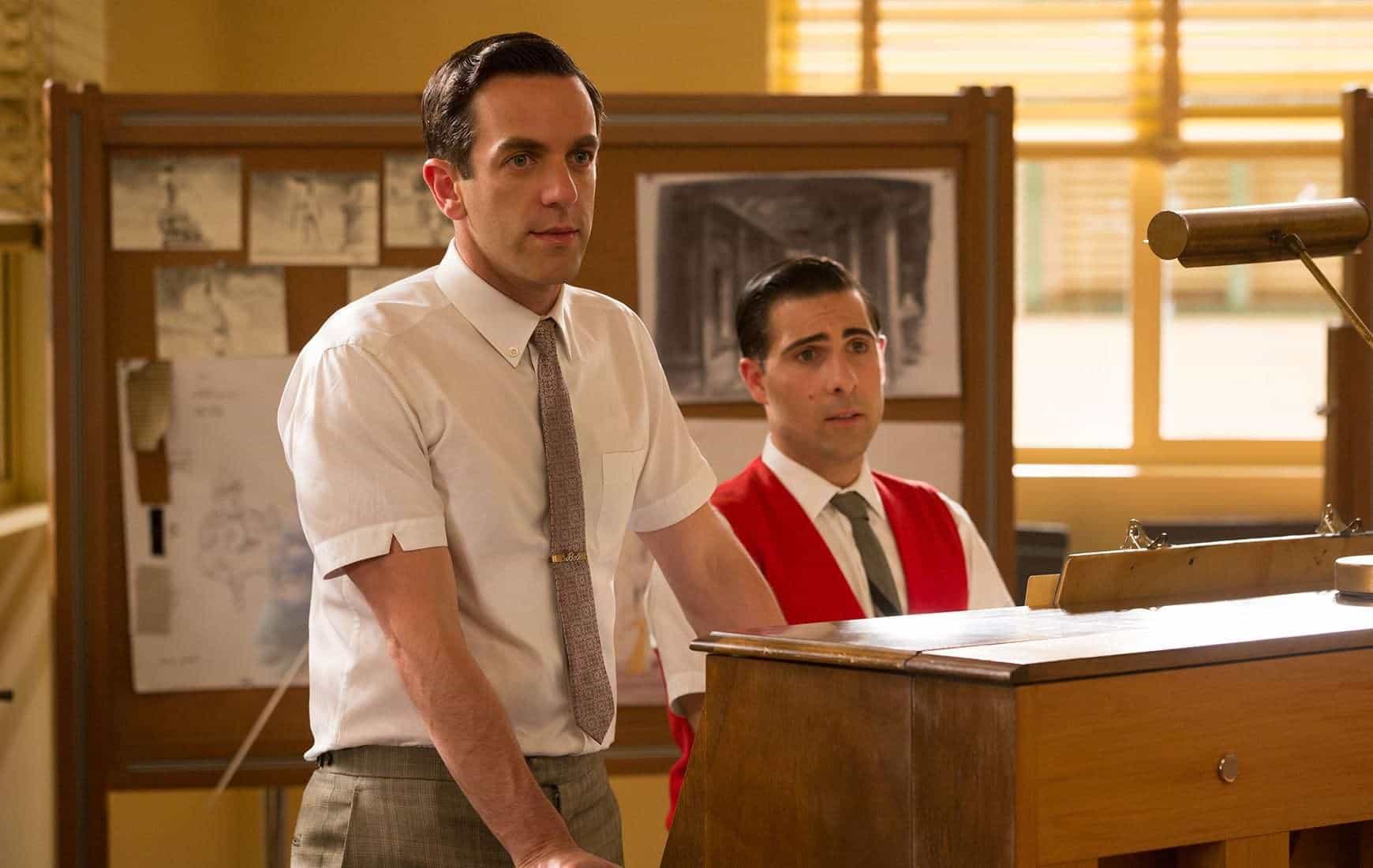
In L.A., Travers meets a cast of characters including her driver (Paul Giamati), the songwriting Sherman brothers (B.J. Novak and Jason Schwartzman) and Don DaGradi (Bradley Whitford), the screenwriter. Along with Hanks, these excellent performances help tell the story of the collaborative development of the script and songs. However, all of this is just a vehicle to help us discover that the real purpose and inspiration behind the original books was simply a coping mechanism for Travers, which we see play out in the Australian timeline.

gallery_08

This dual story is played out in two conflicts: Walt versus Travers and Travers versus herself. Of course, with good storytelling the solutions to these disparate conflicts are actually intertwined, as Walt’s attempts to understand Travers’ protectionist attitude cause the author to examine it herself. The much-anticipated Disneyland scene is part of this. Walt tries to coax Travers into a childhood-like state, which is something she appears to have long buried.

In truth, the best interactions are really between Travers and her driver. This relationship feels the most real and organically developed and will hopefully earn both actors nominations this coming awards season.

Saving Mr. Banks should not be taken as a history text. Despite the fact that history rarely wraps up in the neat little packages films leave behind, the film took other liberties with the timeline as well. References are made to projects and attractions not even conceived at the time. I encourage sticklers to let this go and enjoy the drama unfolding before them. Despite these minor inaccuracies, the movie looks beautiful as a double period piece. The drabness of the outback and the comparative garishness of the 1960s are both evident in the respective scenes. In the film, Disneyland looks as close as the existing version could to what the park looked like in that time period.

Saving Mr. Banks’ strongest asset by far is its acting. The characters all feel human and natural. The story is known and altered for the sake of storytelling, but the movie manages to entertain and enthrall for the entire runtime. It is not necessarily the story of Walt, but it is enough to grab those fans hoping for a closer look at the man behind the magic. I don’t think I can say a higher praise than to call it a docudrama worthy of its subject matter.

Remembering a Legend: Robert Sherman (1925-2012)

Today, this small, small world has gotten just a little bit smaller as we say goodbye and fondly remember Robert Sherman.

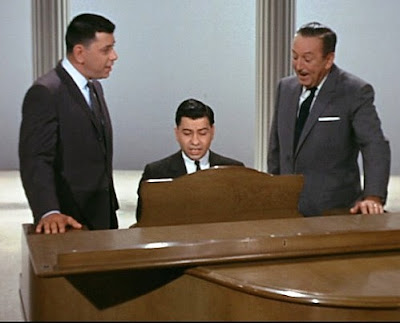
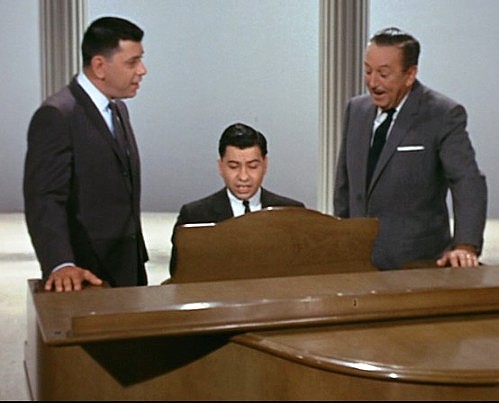
Few things make such an impression on us as music. It fills our heads and refuses to leave our hearts. Weeks after we come back from a Disney vacation, we find ourselves still whistling and humming “It’s a Small World”.  Along with his brother, Richard, Robert Sherman helped to create a gift of music that we will never be able to repay. Our debt includes classic attraction theme songs such as “The Enchanted Tiki Room”, “There’s a Great Big Beautiful Tomorrow”, and “One Little Spark”. Through Robert’s poetry and music, we find a man with a passion for his art and with a true desire to make the world a happier place.

The Sherman Brothers’ music also reaches our hearts through such classic films as the Jungle Book, Chitty Chitty Bang Bang, and Mary Poppins for which they received academy awards. In the words of Robert’s son Jeffrey, “Dad once told me he wished he could stand at the end of the “It’s a Small World” ride so he could shake everyone’s hand as they exited. World peace, charity, love and family were his prayer for the world.”

Robert Sherman may have left this world but he will always live on in our minds and in our hearts. All I can say is bravo and thank you.

– By Josh Hall of WDWNT: The Magazine

Robert Sherman: 1925-2012

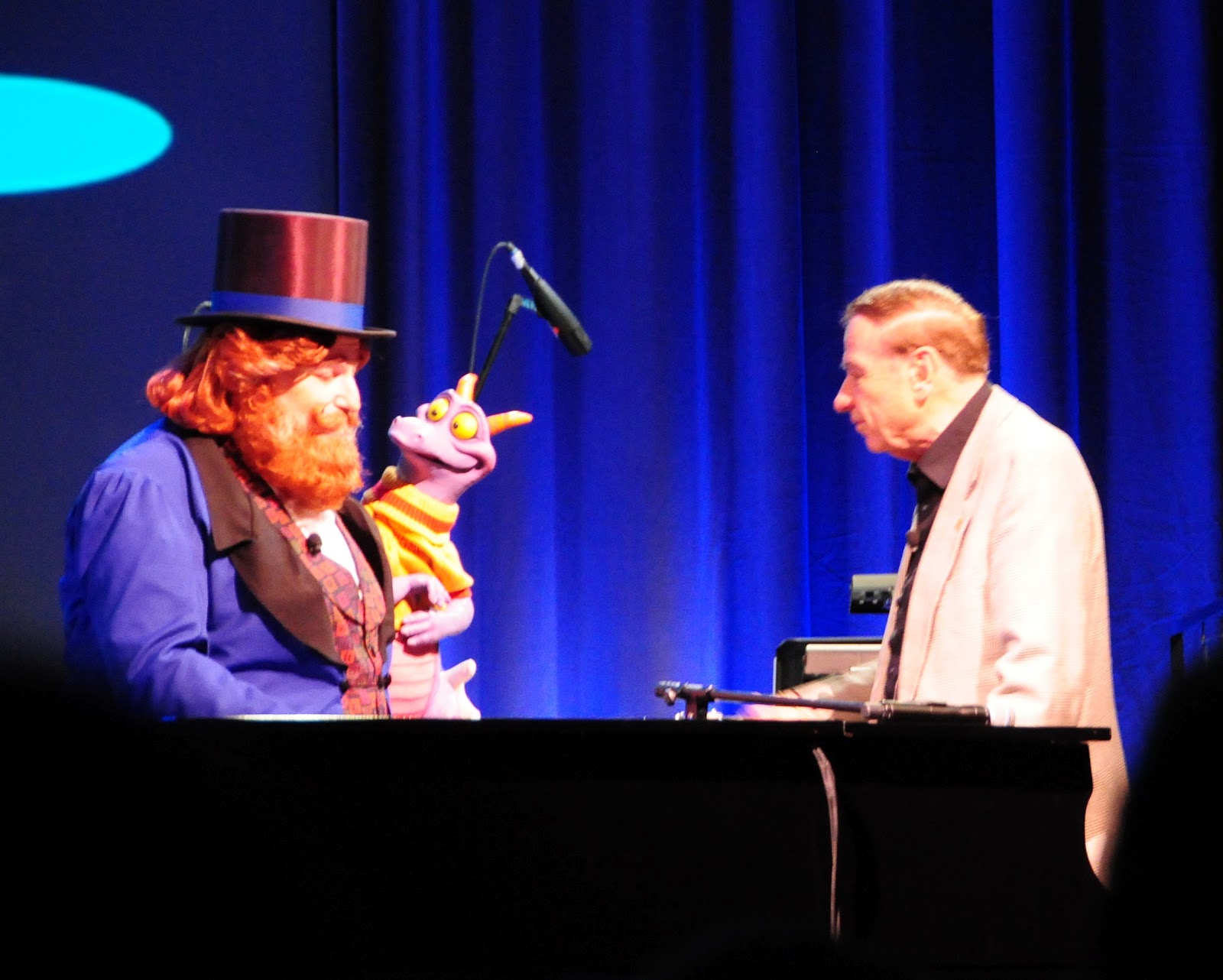
I’m sure, as a Disney fan, you know the legend of the Sherman brothers. They have given us much of the music that will live on forever in both our favorite movies and theme park attractions. Yesterday, the world lost Robert Sherman… a sad day for Disney fans world wide. I consider myself incredibly lucky to have been in the audience a year ago at D23’s WDW 40th celebration where Robert’s brother Richard took the stage to play many classics’s from the duo’s catalog live on stage. Their music has touched all our lives. Interestingly, yesterday was the anniversary of the opening of Journey Into the Imagination at EPCOT. And that attraction’s theme song, “One Little Spark”, was penned by the Sherman Brothers. In honor of the attractions anniversary and the passing of Robert Sherman, Austin took the time to gather a history of the attraction for us and also found some “lost” verses of the song.

Tony Baxter led the design team for this wonderful attraction. Fresh-off of his first thrill attraction, Big Thunder Mountain Railroad, he quickly began exploring several new concepts. One such
concept would eventually become the most successful “unused” project in the history of Walt Disney Imagineering. Discovery Bay was described (by Tony himself) as “a once only place in time.” Situated
on the northern-most banks of the Rivers of America it was to be the kind of place in which Mark Twain, Jules Verne, and H.G. Wells would cross-paths, and probably even call home, Discovery Bay would contain several attractions themed to technological flights of fantasy of the 19th century. The list of attractions contained in the new land were, a flight simulator on the Hyperion airship from Island of the Top of the World, an underwater restaurant where one could dine in the Nautilus while Captain Nemo plays his pipe organ, an elaborate- and thrilling – Spark Gap Electric Loop Coaster, and a carousel theater audio-animatronics tour de force “Gallery of Illusions” in which an eccentric professor shows off his latest discoveries and inventions.
Unfortunately, the film Island on Top of the World, which had served as the inspiration for the land’s centerpiece attraction, the Hyperion flight simulator, “tanked” at the box office. This coupled with the
extravagant plans and budget projected for this new land, all but conspired to bring about the downfall of this radical new concept. But truly great ideas never die at Imagineering, and Discovery Bay would
resurface time and time again in new and unexpected ways.Much of Discovery Bay’s “success” is attributed to the many ways it was recycled over the next two decades. The failure of this new land eventually “sparked” into the Coral Reef Restaurant at Epcot, the entirely new concept for then EuroDisney’s Tomorrowland renamed Discoveryland, and certain elements certainly would apply to the design of Port Discovery for Tokyo DisneySea.

After working on a rejected approach for The Land Pavilion at EPCOT Center, Tony quickly turned his attentions to the Kodak pavilion next door. Kodak had only one request for their Future World exhibition, “They wanted something that would be very imaginative.” So we said: “How about doing a pavilion on imagination,” Tony recalls. Beginning to develop the ideas of such a vague notion as imagination was no easy task. “It was a fun time, and a real challenge, because we had to figure out what Imagination is. It took us six months to come up with a simple thing: “You gather, you store, and you re-combine.” Whether you are a writer, or a scientist, or an artist, or a teacher, or someone making a cake, it is the same thing: “gather, store, and re-combine.” The visual metaphor Tony used to convey this principle to the audience was an inspired invention known (unofficially) as a Dreamcatcher. “Essentially, the Dreamcatcher is a giant vacuum cleaner floating through space” said Steve Kirk, art director for Journey into Imagination. The Dreamcatcher flies through space collecting sparks and storing them in its idea bag, and some of those sparks are re-combined to create something new, in the case of our story; a literal figment of imagination.

The inspiration for Figment would also come from Tony Baxter watching Magnum P.I. “I was watching Magnum PI […] on TV. He was in the garden and the butler, Higgins, had all these plants and they were all uprooted. It was a mess. Magnum had been hiding a goat out there and the goat had eaten the plants. Higgins said, ‘Magnum! Magnum! Come out here! Look at this! Something has been eating all the plants in the garden.’ And Magnum says, ‘Oh, it’s just a figment of your imagination.’ And Higgins said, ‘Figments don’t eat grass!’ I thought, ‘There is this name, the word ‘figment’ that in English means a sprightly little
character. But no one has ever visualized it, no one had ever drawn what a figment is. So, here is a great word that already has a great meaning to people, but no one has ever seen what one looks like.’ So we had the name that was just waiting for us to design the shape for it.”” –Tony Baxter

Over 78 new special effects were created by Disney Imagineers for the Journey Into Imagination pavilion – more than all of those found in Walt Disney World on opening day in 1971.The attraction’s most unique feature, the turntable that allowed for a “stationary” scene on an Omnimover attraction, would be one of the most difficult parts of the attraction to develop and the first thing to go when the attraction
was replaced. The vehicles would lock into place on one of five identical scenes like cogs and then unlock to go onto the track containing the rest of the attraction. This “stationary” scene was a master stroke of genius that has not been repeated to this day. What is even more impressive is that this level of sophistication was
achieved by a relative novice. Tony Baxter had only one completed project, Big Thunder Mountain, before Imagination and this fact is a testament to the genius of his team, and the engineers involved with
this project. The rest of the Ride featured an exploration into the more creative endeavors of imagination: the [Visual] Arts, Literature, Performing Arts, Science and Technology, and finally Image Technology.

Over the years many rumors have surfaced in regards to Imagination’s turntable. One such rumor is that the reason for its removal was due to its in-operation on a daily basis. The original Journey into
Imagination ran successfully for a period of 15 years (from 1983-1998). Another rumor speculates that the turntable was slowly screwing itself into the ground. This would require a large amount of
industrial mining equipment to be installed on the bottom of the turntable. In addition, the grinding would have cause major damage to the concrete foundations that could not be corrected in the amount of
time taken for the conversion between the original and second versions of the ride.Whether these are true or not, I don’t know but it’s always fun to speculate.

As part of the original plans for Discovery Bay the “Gallery of
Illusions” was to be hosted by inventor/discoverer Professor Marvel, a
“Santa Claus-type, who is wise and older and knows all great things-a
great thinker” as Tony described. In one pivotal scene, the professor
demonstrates his domestication of dragons. Toward the end, he’s seen
holding a newborn green baby dragon. This image would later serve as
the inspiration for the Professor’s sidekick. Dreamfinder, himself
however, was modeled after Imagineer Joe Rhode who later oversaw the development, construction, and operation of Disney’s Animal Kingdom. Dreamfinder’s voice was supplied by comic actor Chuck McCann and Ron Schneider. The voice of Figment was a little harder to cast. Imagineers tried men, women, boys, and girls even having adults inhale helium, but no one had the right voice. Until they found veteran performer Billy Barty whose voice was perfect for the 3 foot tall purple dragon.

The pavilion itself started its design phase a full year later than its Future World Neighbors. However, it was still slated to be one of the opening day pavilions of the park. While the Pavilion opened, with
the rest of the park on October 1st, 1982, (technically, only the Image Works was open and five days later Magic Journeys) the centerpiece attraction was “ready to go, everything was running and
they made the call that the show was not perfected enough to guarantee the reliability they wanted,” Baxter said. However, considering that EPCOT Center’s opening day was presumably worse than Disneyland’s “Black Sunday,” Imagination was probably just as ready on opening day as the rest of the park. Considering the unreliability of all the attractions during those first few months upper management was probably wary to add more fuel to the fire that was opening day. With the extra time, Journey into Imagination opened on March 5th 1983. Although not without its’ own set of unique problems, most operational issues stemmed from the loading and unloading belts. Loading was performed on a stylistically beautiful but problematic curved belt. Unloading was difficult at best. Due to irregular intervals, the vehicles and the belt could not synchronize properly. Eventually, Unload was performed without a moving belt. From the first day it opened, the Journey into Imagination was one of the most popular attractions in the park. Excluding the morning rush at Spaceship Earth, Imagination had the longest wait time of any attraction in the park. Forty-Five minute wait times were common, and the extended queue was always kept up. Ironically, the popularity of the pavilion was entirely unexpected or planned for. As David Koenig put it… “Disney executives had always acted embarrassed about having an EPCOT pavilion devoted to a lightweight, non-scientific topic like imagination and starring a cartoon dragon. So, in publicity for Future World, Disney had always touted pavilions on ‘energy, transportation, communication and other topics for tomorrow.’ Imagination, the park’s surprise sensation, was always ‘other topics’.”

Well there’s the basic history of Journey into Imagination. Here are a few fun facts starting off with lost lyrics, and ending with specifications for the original ride.

Like most songs, “One Little Spark” went through several revisions and had several verses written before the final version was settled on.
Usually those scrapped verses never make it to the public, but one
verse of “One Little Spark” has. In “A Souvenir Disney Songbook –
Favorite Songs from Disneyland & Walt Disney World” ((c) 1994 Hal
Leonard Publishing Corp.), this “lost” verse can be enjoyed:

One little spark
One flight of fancy
Shines up the dark
So that we can see
When things look grim
And nothings going right
One little spark
Clicks on the light

And here’s another “lost” verse that was originally going to be just
between when Dreamfinder says “And every sparkling idea can lead to
even more.” and just

before the “So many times, We’re stumbling in the dark” line:

One bright idea
One right connection
Can give our lives
A new direction
So many times we’re stumbling in the dark
And then, Eureka! – that little spark!

Capacity: 2,576/Hour
Show Time: 13:00 Minutes
Cycle Time: 15:00 Minutes
Type of Ride System: Wedway/Omnimover
Maximum Number of Vehicles: 92
Spare Vehicles: 8
Seats per Vehicle: 7
Vehicles per Train: 4
Ride Length: 1,460 Feet (438 m)
Ride Speed (average): 0.88 to 5.00 Feet/Second (0.264 to 1.5 m/s)
Total Pavilion Square Footage: 128,173 (11,535.57 m2)

Information taken from:
http://disney.wikia.com/wiki/Journey_Into_Imagination
http://www.intercot.com/edc/Imagination/jfacts.html
http://www.wdwhistory.com/wiki/Journey_into_Imagination_%28ride%29
http://epcot1982.blogspot.com/2010/06/gather-store-re-combine-history-of.html

VINYLMATION THAT FEATURE JOURNEY INTO THE IMAGINATION:

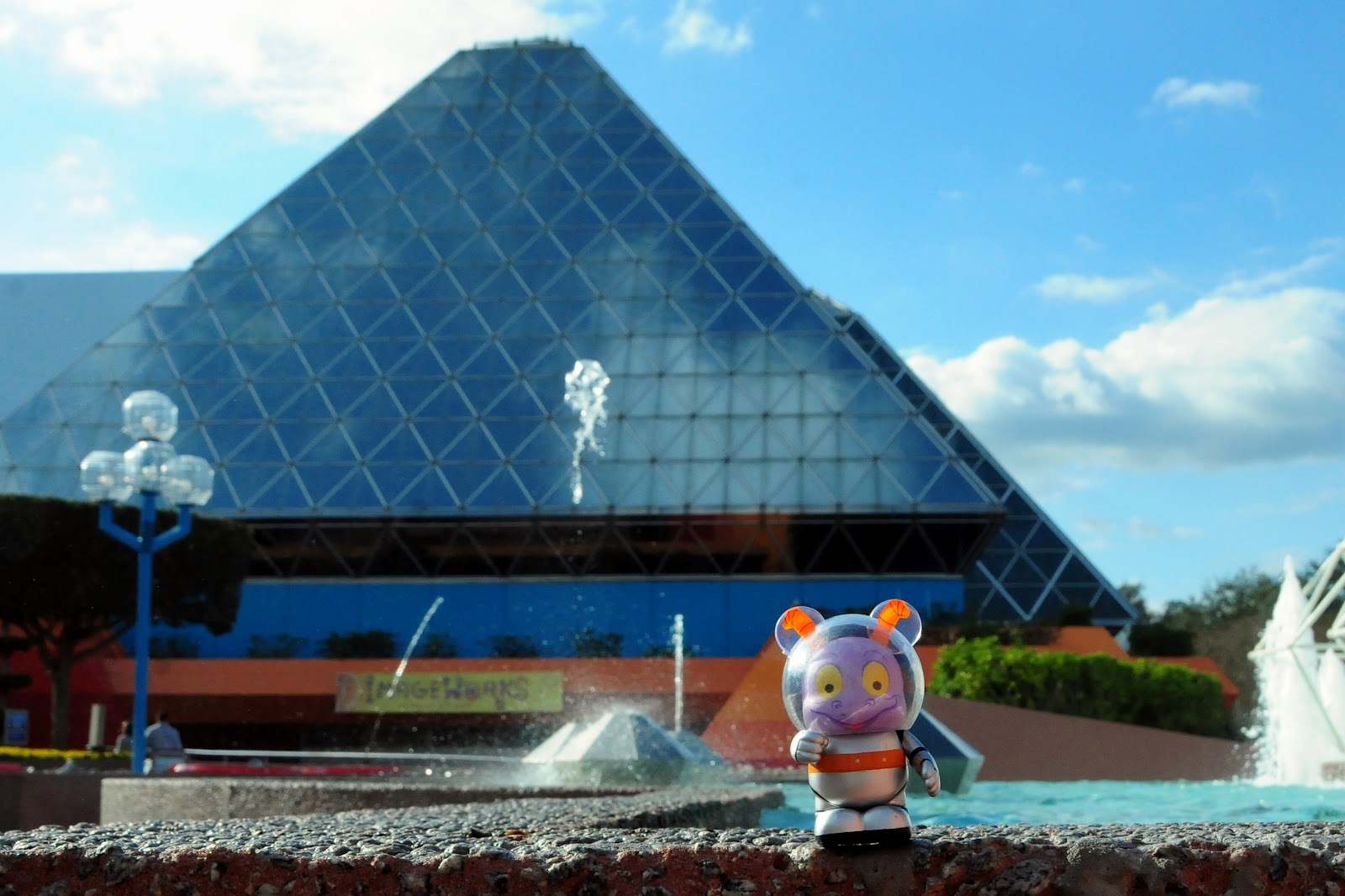
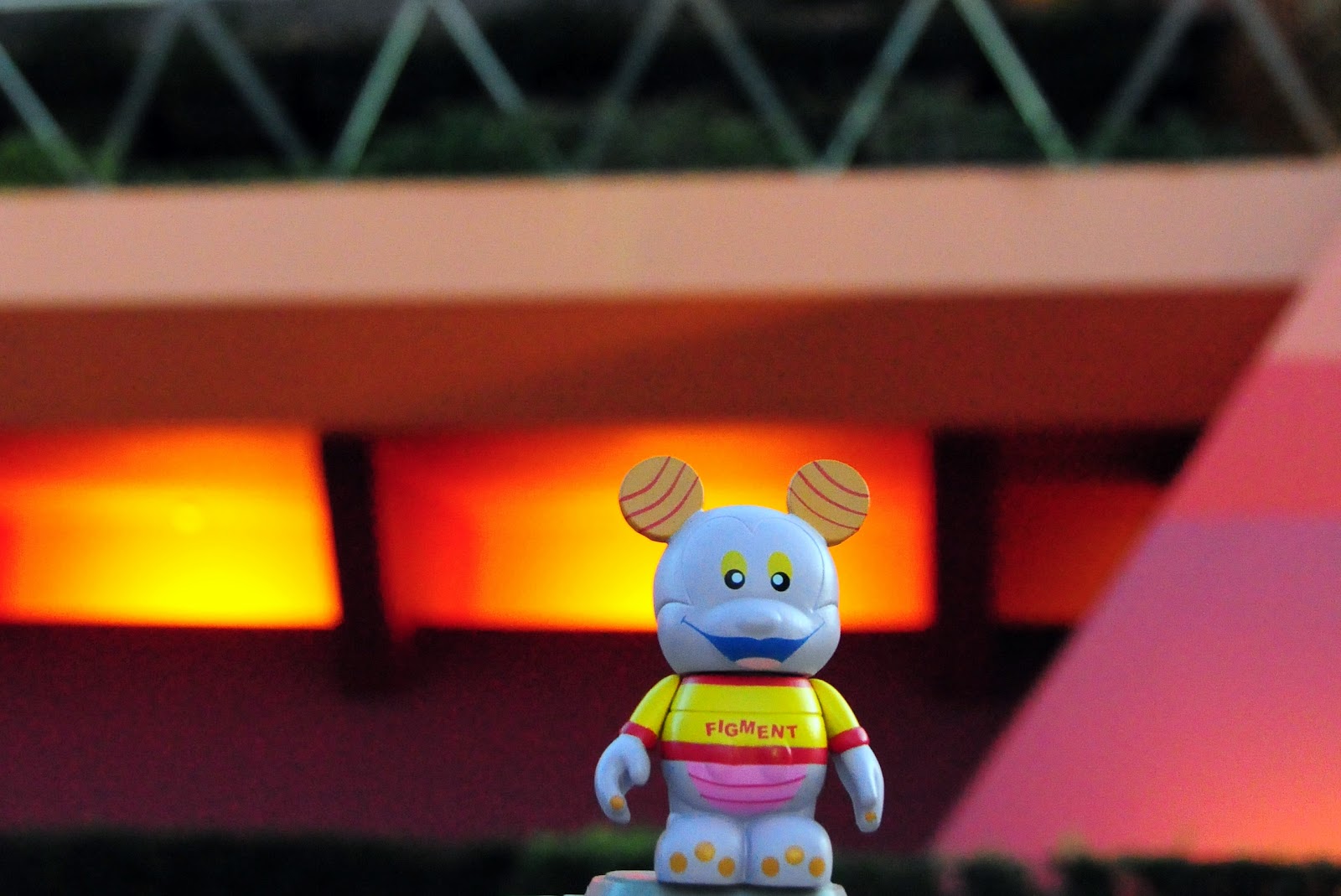
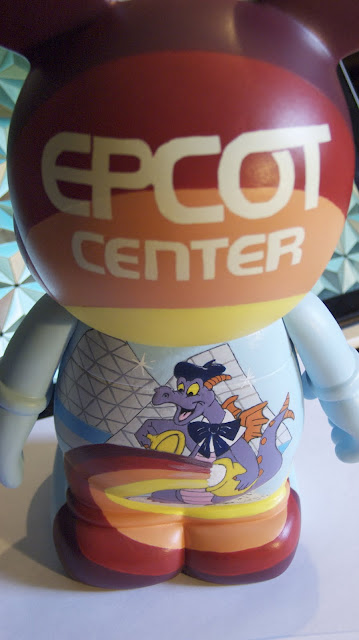
Park 1 Figment, Park 5 Dreamfinder/Figment 9/3 combo and Park 7 Figment. There is of course also a Park Starz Figment already released and a Nerds Rock! version coming out soon. I would also be remiss to mention custom artist Justin Marshall who has an obsession with Journey into Imagination customs.